Self-organization helps to independently build work: to understand what result you need to come to, to collect tasks, to choose priorities, to plan the workload and bring it to the end.
In this article, we will analyze what actions self-organization consists of, how to connect goals with daily tasks, what methods to use for prioritization, planning and focus, and what tools help maintain such a system every day.
What is self-organization?
Self-organization is the ability to independently determine the order of work: set goals, turn them into concrete actions, prioritize, plan time and load, monitor implementation and adjust plans.
It is not only in the absence of external control. Even when working in a team, a person independently decides in what order to perform their tasks, how many cases to take at the same time, where to fix the deadline and how to rebuild the plan after new information appears.
Self-organization encompasses a broader process than individual time planning. Time management helps to allocate hours and days, self-discipline helps to execute a decision, and self-organization links goal, tasks, priority, time, execution and revision of the result into one work system.
What constitutes self-organization
Self-organization is built as a sequence of actions: determine the result, collect commitments, turn large work into clear tasks, prioritize, plan the real load, perform the selected and revise the system.
- Determine the outcome. Understand what needs to be achieved and on what basis the work will be considered completed.
- Gather tasks. Keep your work and personal commitments in one place so you don’t keep them in your memory.
- Clarify and decompose. Break down large projects into concrete actions with clear results.
- Prioritize. Determine which tasks have a stronger impact on the goal, timing and other work.
- Plan the load. Compare the to-do list with the available time and already started tasks.
- Execute your choice. Keep your focus and not open too many things at the same time.
- Review the result. Close the completed, update deadlines and priorities, and choose the next focus.
This sequence connects the strategic level with the daily work. Goal defines direction, tasks translate it into action, priority sets order, planning limits scope, and revision brings the system back to its current state.
How goals relate to self-organization
The goal defines the result against which a person assesses the importance of tasks and decides what to spend time on.
Without a goal, the to-do list quickly turns into a set of unrelated errands. Urgent and simple tasks get attention first, although they do not always get closer to the desired result. Connecting with purpose helps to distinguish the really important work from the activity that is convenient to perform, but which has little effect on anything.
For practical planning, it is enough to build a chain:
The goal → the project → the task → the next step
For example, the goal of “launching a new website” is too big for a daily list. It is more convenient to present it as a project with a specific result, and then break it down into tasks: agree on the structure, prepare texts, make a design, compile pages and conduct a check. For each task, a specific next action is already defined.
The formulation of the objective should provide a criterion of completion. Instead of “studying English” it is more useful to define the result: “prepare for an interview in English by November.” Then it becomes clearer which actions are related to the goal and which do not require attention now.
How to break projects into specific tasks
Big work needs to be broken down to the level of actions that understand how to start, execute and complete.
A project differs from an individual task by the number of steps required. “Organize relocation” is a project: it includes finding a carrier, packing things, transferring keys and other activities. “Calling three carriers and asking for a price” is a specific task that can be completed in one working approach.
Decomposition is especially useful for tasks that are regularly postponed. The wording “prepare a presentation” does not indicate the first step. After splitting, clear actions appear: collect data, compile a structure, prepare three key slides, add examples and check the final version.
A good task answers at least two questions:
- what specific action needs to be performed;
- On what basis it is clear that the action is completed.
A checklist is required for small steps within a single task. It is better to create individual cards or list items for actions with their own deadline, priority or noticeable workload.
How to prioritize
Priority indicates which task is worth performing before others, taking into account its impact on the outcome, timing and consequences of delay.
Urgentness alone does not make the task important. A letter with a quick response time can distract from the work on which a large project depends. When choosing a priority, it is useful to consider several factors:
- target How close the task is to the desired result;
- deadline - when the result should be ready;
- delay What happens if you put off work?
- dependency Whether other actions or people are waiting for the task to be completed;
- volume How much time and attention it will take to complete.
As a result, priority becomes a relative rather than a permanent property of the task. The case, which is at the bottom of the list today, rises higher tomorrow after a deadline change, addiction or new information.
How to plan tasks for the week and day
Planning is conveniently conducted on three levels: a common list stores all obligations, a weekly plan sets the nearest volume, and a plan for the day determines the specific focus.
The list should not become a plan for today. It can contain dozens of future cases, ideas and tasks without an immediate deadline. For a week, choose only what really needs to advance in the coming days. On the day – several actions that are placed in the available time along with meetings and mandatory events.
Time and time of execution solve different tasks. Deadline answers the question “by what point should the result be ready”, and the time block in the calendar – “when I’m going to do it”. A report with a deadline on Friday can be scheduled for Wednesday from 10:00 to 12:00, leaving room for verification and correction.
General list → week plan → day tasks → current work
It is useful to make a plan of the day not by the number of points, but by the expected volume. Three complex tasks can take longer than ten short ones, so the same number of points does not mean the same load.
How to consider the load and not start too many things
The real workload consists of tasks already started, new commitments, meetings and available time, not just the number of items on the list.
A common mistake of self-organization is to plan as if all day is free for new tasks. Part of the time is already busy with current work, communication, mandatory events and unexpected requests. A new plan needs to be built on top of that load, not in its place.
It is especially important to consider unfinished work. The five tasks that have begun require a constant return to context: remembering what has already been done, finding the materials, and understanding the next step. The more parallel cases, the harder it is to maintain a steady focus.
Practical principle: First make room in the current work, then take the next task. The restriction does not apply to the entire list of cases, but to the number of simultaneously started work.
What methods of self-organization exist
Methods of self-organization solve different problems: GTD helps to disassemble the flow of incoming cases, the Eisenhower matrix – to choose priority, time blocks – to fix time in the calendar, Pomodoro – to hold attention, and Kanban – to see the movement of tasks and limit the amount of work started.
GTD helps relieve the flow of incoming tasks
GTD, Getting Things Done, is suitable for a large number of heterogeneous commitments that are difficult to keep in mind and regularly review.
The method is built around five actions: capture, clarify, organize (organize), reflect (revise) and engage. First, incoming cases are recorded in an external system, then specified whether they require action, determine the next step and put in a suitable list or project.
GTD is especially useful in situations where new orders come from different sources: mail, messengers, meetings and personal notes. The system reduces the risk of loss of commitment, but requires regular review of incoming and revision of lists.
The Eisenhower Matrix helps assess urgency and importance
The Eisenhower Matrix fits when the task list is already compiled, but urgent matters constantly crowd out important work.
Each task is judged by two attributes—importance and urgency—and assigned to one of four options: do now, schedule, delegate, or eliminate. The method does not replace a full-fledged priority system, but it helps to quickly disassemble an overloaded list.
Urgent + important Do it first.
Not immediately. Schedule the time.
Urgent + whatever. Delegate or reduce.
Not immediately. Take it off the plan.
Time blocking fixes time for specific work
Time blocking is suitable when a to-do list is compiled, but the workday is filled with meetings, messages and unscheduled requests.
Instead of a general intention to “do today,” a person reserves a specific interval in the calendar. For example: from 10:00 to 11:30 – presentation preparation, from 12:00 to 12:30 – responses to messages, from 15:00 to 16:00 – training. The method helps to check in advance whether the plan fits in the available time.
Pomodoro helps to work in short focused intervals
Pomodoro (Pomodoro technique) is suitable for tasks that are difficult to start or difficult to keep your attention for a long time.
The work is divided into limited intervals with short breaks between them. The classic format uses 25 minutes of work, but the main idea of the method is to limit the working period in advance and do not switch to other things until it is completed.
Kanban shows the movement of tasks and limits parallel work
Kanban is suitable when a person starts many things at the same time and loses understanding which ones are actually progressing to completion.
Tasks are placed on the board and moved between stages as they are completed. For personal work, a simple scheme is enough:
All tasks → Planned → In work → Ready
An important principle of kanban is to limit unfinished work. The “In Work” column should not be filled with new cards indefinitely. The next task is taken after one of the current tasks is completed or advanced.
This approach makes overload visible: a common list can contain dozens of cases, but only a few remain active at the same time. As a result, less time is spent switching between contexts.
How to choose a method of self-organization
The method should be chosen for a specific problem, not for popularity: different techniques are responsible for collecting obligations, priority, time, concentration and load limitation.
- Many incoming tasks — GTD;
- I don't know what's more important. - the Eisenhower matrix;
- There is no time left for important tasks. - temporary blocks;
- Difficult to start and hold attention — Pomodoro;
- Too many things at once. - Kanban.
The methods are not mutually exclusive. Tasks can be collected by GTD, evaluated through the Eisenhower matrix, conducted on the kanban board, and for important actions reserve time in the calendar. The system remains comprehensible until each method solves a specific problem and creates more work to service the planning itself.
What tools are needed for self-organization
Self-organization tools help to store tasks, deadlines, and context out of memory, as well as keep the chosen way of planning in practice.
For a basic system, one task space and a calendar for meetings and time blocks are usually enough. Notes and timers are connected as needed. The more information is duplicated between applications, the greater the risk that part of the system will stop updating.
How to Regularly Review Plans
Revision returns relevance to the system: completed tasks are closed, new ones are disassembled, overdue deadlines are updated, and priorities are changed taking into account the current situation.
Daily viewing is needed for the nearest focus. At the beginning or end of the day, it is enough to check the current work, mandatory events and several following tasks. This does not require you to re-plan the entire system.
The weekly review covers a larger horizon. During it, it's helpful:
- close the completed tasks;
- Remove what has lost relevance;
- Discuss new obligations;
- Check deadlines and dependencies;
- See what tasks remain in the work for too long.
- Identify priorities for the next week.
The revision turns planning into a cycle: Plan → implementation → verification of the result → adjustment. Without this, even a carefully compiled list gradually ceases to reflect the real situation.
How to organize repetitive cases
It is better to separate repetitive tasks from one-time tasks and return them to the system on a schedule, rather than re-deciding each time whether they should be performed.
A weekly report, training, paying bills, or regularly checking documents is different from a project: they do not have a single point of final completion. The action is repeated with a given frequency and after execution appears again.
Regular activities are conveniently associated with a specific day, event or ritual. For example, every Friday there is a weekly review, on the first working day of the month - check payments, after the end of the working day - a short analysis of incoming tasks.
How to build a system of self-organization
It is easier to build a working system of self-organization from a minimum set of rules, and then add methods and tools only for specific problems.
- Choose one place for tasks. Move work assignments, personal affairs, and commitments that require action.
- Separate projects and individual tasks. For major work, determine the result and the next concrete steps.
- Prioritize it. Assess the impact on purpose, timing, delay and dependency consequences.
- Choose a realistic amount for the week and day. Take into account the work already started and the busy time.
- Limit the number of active tasks. Start a new job after completing or promoting the current one.
- Set time for a review. Update the nearest focus daily, and check the entire system once a week.
A simple criterion of the working system: At any time, it is clear what needs to be achieved, what tasks exist, what is more important now, what is already in the works and where to look at the next step or deadline.
How to Use Kanban Board in Kanbano for Self-Organization
In Kanbano, a personal system can be built around a single kanban board: collect tasks in cards, distribute them in stages, and move on as you complete them.
For personal planning, a simple structure is suitable:
All tasks this week in the works Ready
The general list stores future affairs, the “This Week” column sets the nearest volume, and “In Work” shows the current focus. It is better to limit the number of cards in the active column yourself, so that the new task is not added to the already overloaded list.
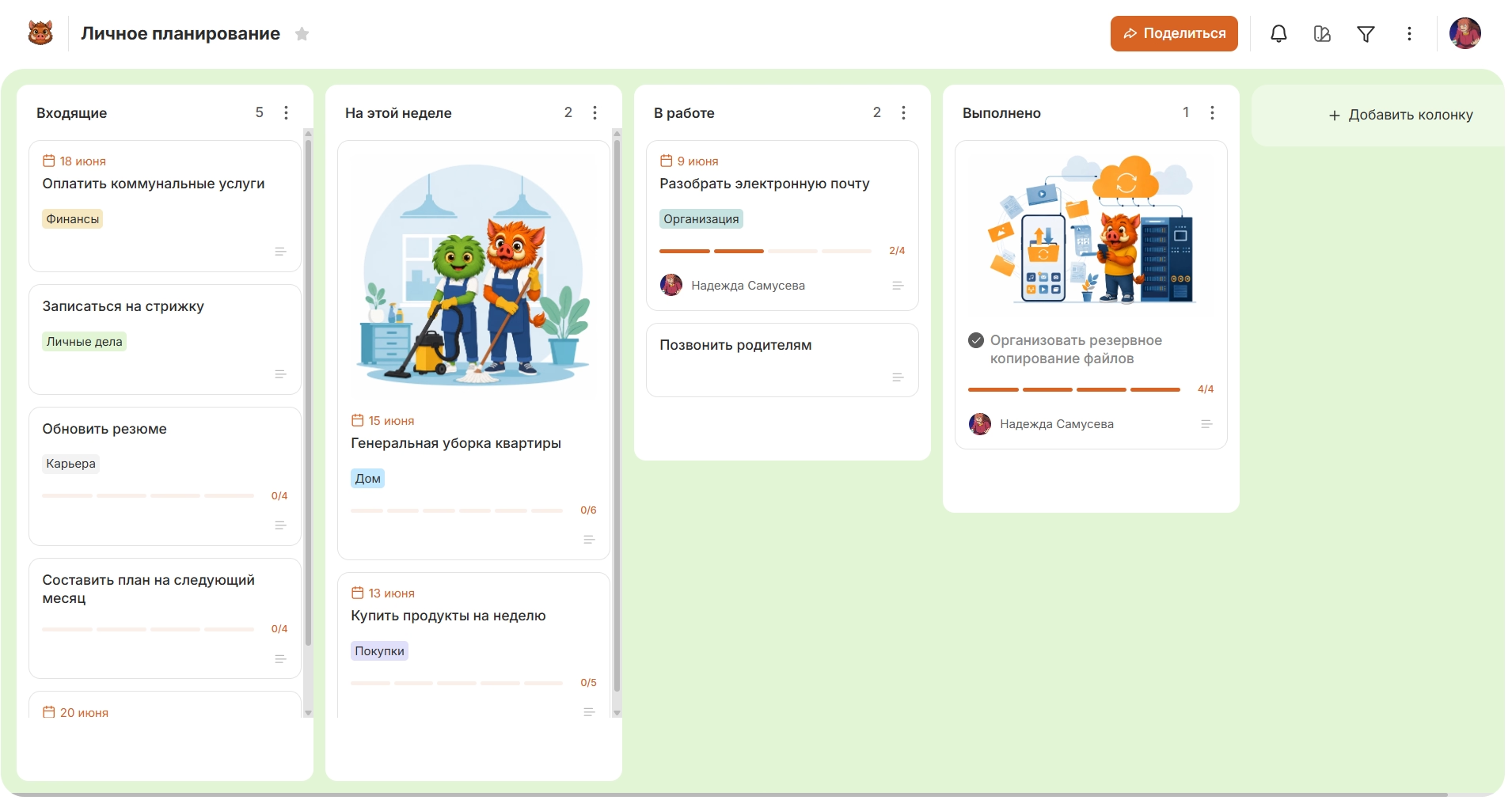
Keep details inside the card
In the Canbano card, a description, performer, date, labels, status, checklist and attachments are available. For personal self-organization, date, checklist, labels and materials are especially useful.
- date fixes the duration of a particular case;
- checklist Break down a large task into small steps.
- labels help to separate work, personal or educational tasks;
- deposit Store the necessary materials next to the card.

Selecting the right tasks
Filters help select cards by status, date, labels and other parameters. On a common board, it is easier to see separately, for example, urgent tasks or cases of a certain direction, without creating a separate list for each collection.
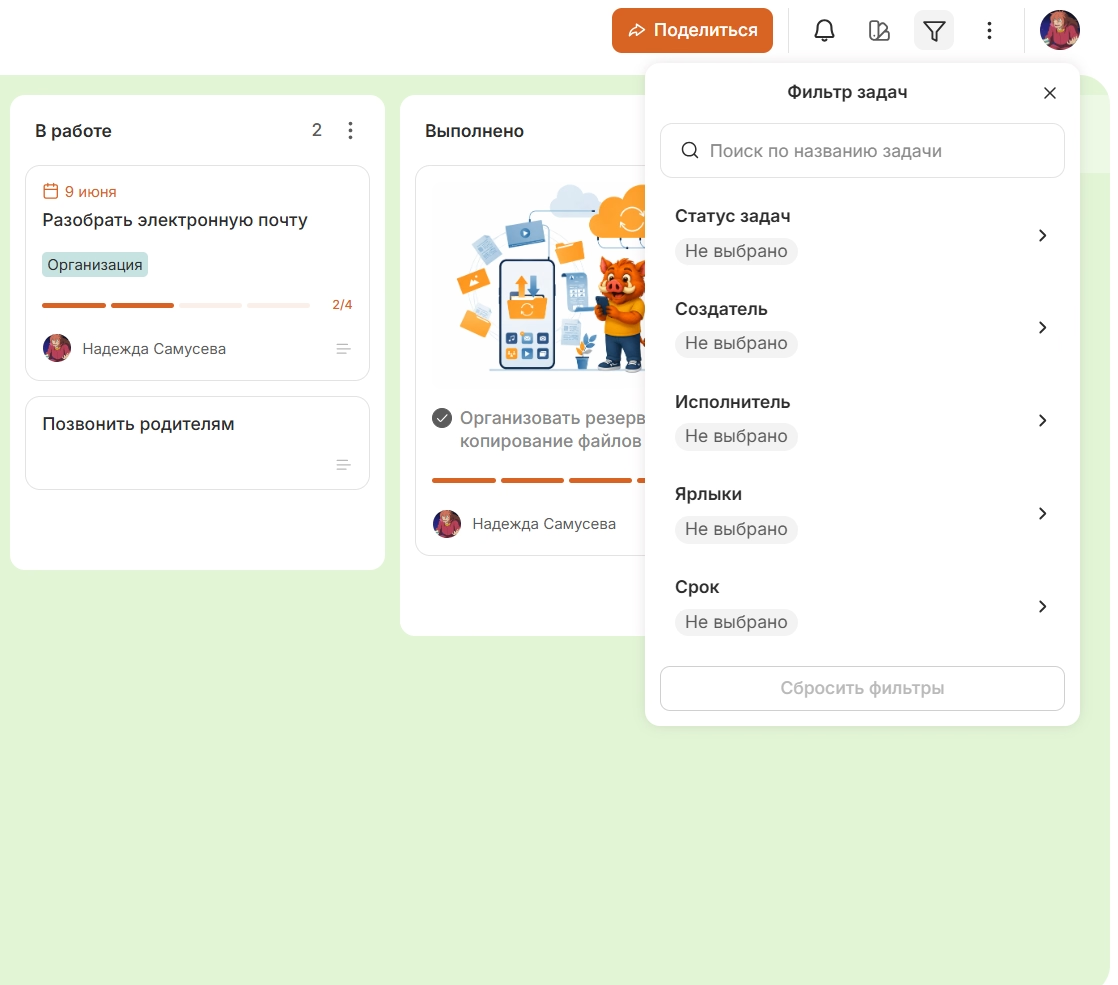
Remove completed from current work
Executed and temporarily irrelevant cards can be sent to the archive. They cease to occupy space on the active board, but are preserved and restored if necessary.
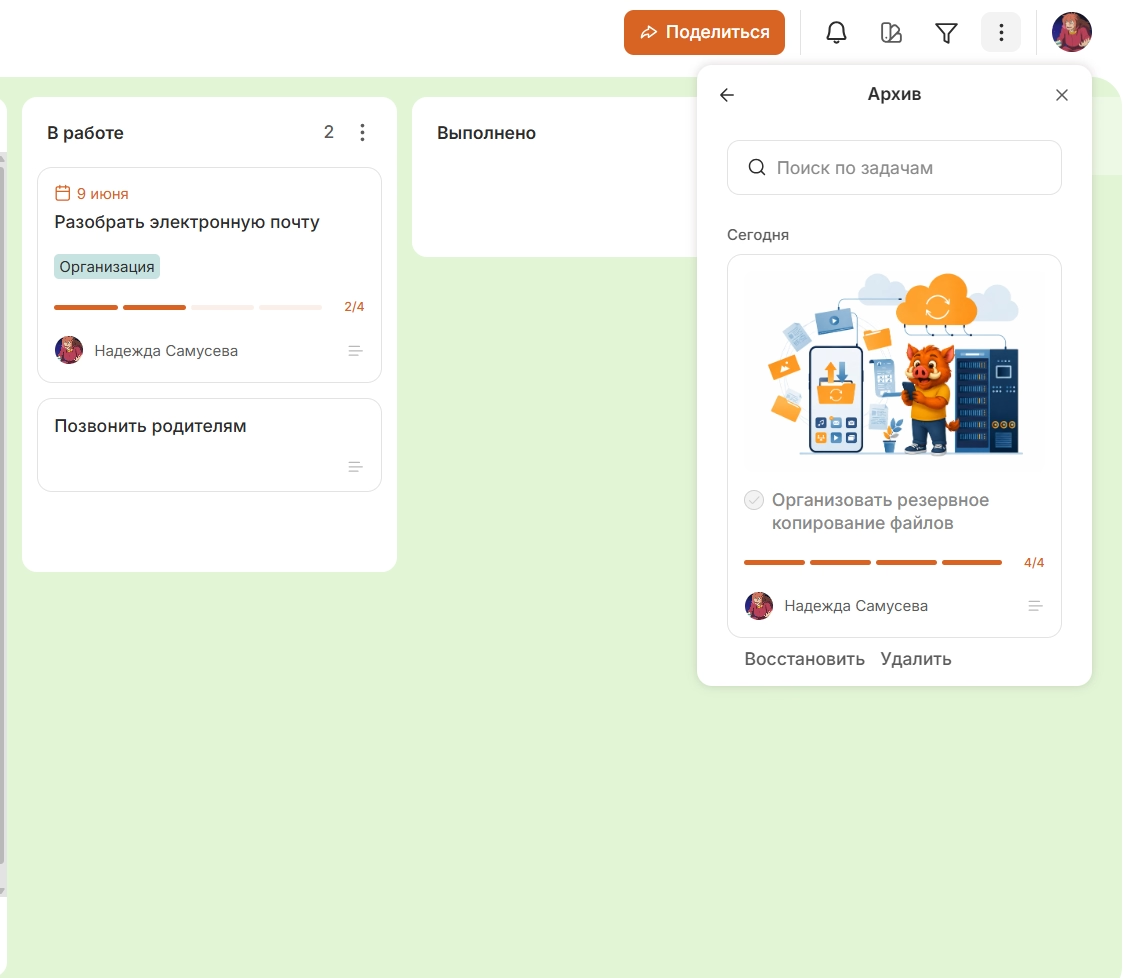
Working from a computer and phone
Kanbano works in the web version and apps for Android and iOS. One task system remains available from a computer and smartphone, so a new case can be immediately recorded in the same whiteboard, and not transferred later from notes.
What ultimately helps self-organization
Self-organization works as a connected system: the goal sets a direction, projects and tasks translate it into actions, priority determines order, planning limits the load, and revision helps to adjust the solution in time.
It is not necessary to implement all methods at the same time. At first, one place is enough for tasks, an understandable prioritization rule, a realistic plan for the week and day, and limits on the amount of active work. The GTD, Eisenhower matrix, time blocks, Pomodoro, and Kanban are plugged in when a specific problem to be solved appears.