Pomodoro is a way of organizing work in which the selected task is performed by timer, alternating working intervals with rest. The basic scheme includes 25 minutes of work, a 5-minute short break and a longer rest after four work intervals. The technique was developed by Francesco Cirillo, and the name is associated with a kitchen timer in the shape of a tomato.
Below we will check the scheme on one task: prepare it for the first interval, analyze interruptions, breaks and unfinished work, and then save the actual result in the card on the kanban board. Separately consider the conditions under which a hard timer interferes with work.
How to prepare a task for the first interval
Choose one executable action with a verifiable result and make sure that the next 25 minutes are not busy with a meeting, a mandatory call, or other work that cannot be put off.
The timer does not determine which case is more important. Before starting the interval, you need to defineMatch tasks with deadlines and available time, and then select one job for a focus approach.
Let's take a case study: prepare a draft letter to the supplier with questions about the price, delivery time and delivery conditions.
Before the timer starts:
- Open the offer of the supplier and other necessary materials;
- formulate the result of the current approach;
- Turn off optional notifications;
- Choose a separate timer;
- Write down a preliminary estimate - one working interval.
One interval in this example is a conditional estimate, not a rate of speed for business correspondence. The actual work will show whether the selected segment was enough or the task requires continuation.
How to divide a major task into actions
Divide the big work into parts with a separate clear result. For the first interval, choose one step rather than the whole project.
The challenge “Find a new supplier” It includes several independent actions:
- collect delivery requirements;
- select suitable options;
- compare conditions;
- prepare questions;
- Send a letter to the selected supplier.
The first interval in our example refers only to the preparation of the letter.
Several pre-selected small similar cases are combined into one approach. For example, one interval is allocated to three short non-urgent letters. New incoming ones are not added to this list during countdown.
How to spend the working interval on a timer
Start the timer for 25 minutes and work only on the selected action. After the signal, save the actual result, mark the full interval and proceed to rest.
The first approach consists of six actions:
- select a specific job;
- start the timer for 25 minutes;
- Do not switch to other scheduled activities;
- at the signal to complete the current interval;
- record the result obtained;
- move on to a short break.
In our example, the working action is the preparation of a draft letter to the supplier. The timer defines the boundary of the approach, but does not define the readiness of the letter.
To the signal, questions about the price and timing have already been formulated, and the wording for delivery still requires checking the original offer. The work interval is complete, the task is not.
For the first acquaintance with the technique, one approach is enough. Four intervals are needed further to explain the long break, not as the required amount of work per day.
What to do if the task ends before the signal
Use the remaining time to review the same work or related materials.
The draft, completed in the twentieth minute, leaves five minutes to check the wording, addressee and initial offer of the supplier. Switching to random notifications violates the boundary of the selected work unit.
When the timer stops before the signal, the actual interval is not recorded as a full 25-minute interval.
Another duration requires its own accounting rule. The work of 15, 20 or 40 minutes is fixed separately, and different segments are not equated to the same unit.
When to take a break after work
After the first three full work intervals, take a short break for about five minutes. After the fourth, move on to a longer rest.
The baseline cycle looks like this:
25 minutes of work → 5 minutes of rest → 25 minutes of work → 5 minutes of rest → 25 minutes of work → 5 minutes of rest → 25 minutes of work → long break.
A short pause separates one working approach from the next. At this time, you should get out of the working context: get up from the table, walk or switch to a simple action that is not related to the current task.
Answering emails, checking chats, and viewing the next task continue the workload, so this segment does not serve as a break.
Real responsibilities are more important than the timer. A mandatory call, meeting or necessary rest is not postponed for the sake of maintaining the consistency of the countdown.
When you need a long break
A long break begins after the fourth full working interval and replaces another short pause.
For a training example, take 15 minutes:
25 + 5 + 25 + 5 + 25 + 5 + 25 + 15 = 130 minutes.
In 130 minutes, there are four working intervals, three short breaks and one long one. Clean work takes 100 minutes.
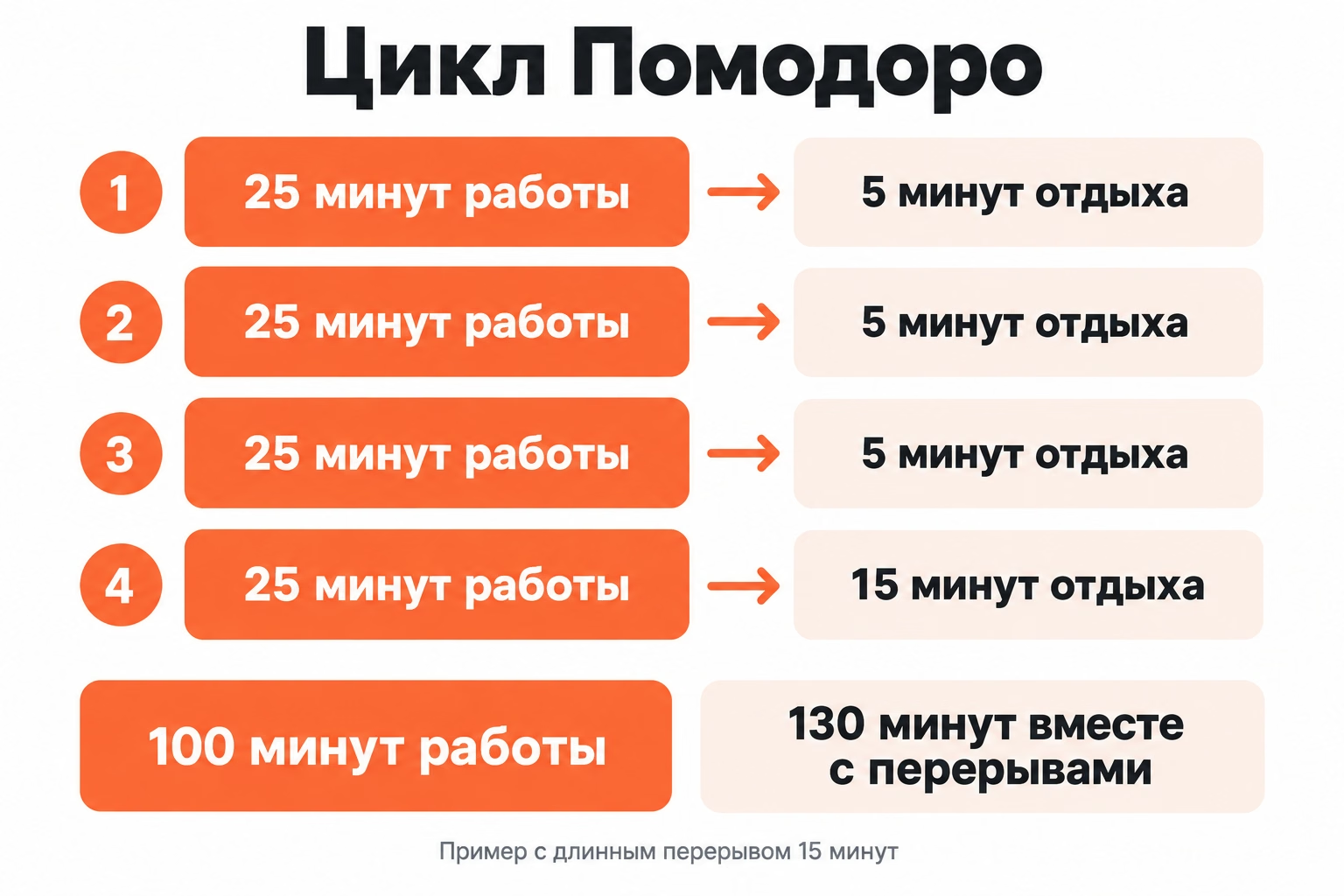
In the basic scheme, a long rest takes about 15-30 minutes. Fifteen minutes in our example are needed for a specific timeline rather than a mandatory duration for each work situation.
The resulting 130 minutes cannot be considered a ready-made working block schedule. The calculation does not include the preparation of materials, meetings, external appeals and other duties.
How to deal with distractions while working
Write down the non-urgent thought briefly and return to the chosen action. External treatment is assessed by actual urgency and work duties.
The internal distraction looks like this: during the preparation of the letter, a person remembers that it is necessary to order a cartridge. Instead of switching it is enough to write down "order a cartridge." and continue the letter.
With colleagues, agree in advance on periods of inaccessibility and how to communicate for really urgent questions. Dealing with customer calls, incidents or other operational tasks requires maintaining the required level of availability.
Urgent communication, emergency situation or mandatory working action are not ignored for the sake of maintaining the interval.
Repeated calls also provide information about the workflow. Continuously interrupted 25-minute segments show that the chosen mode does not meet the working conditions. In this case, the problem is not in the number of timer restarts, but in the very ability to protect the focal length.
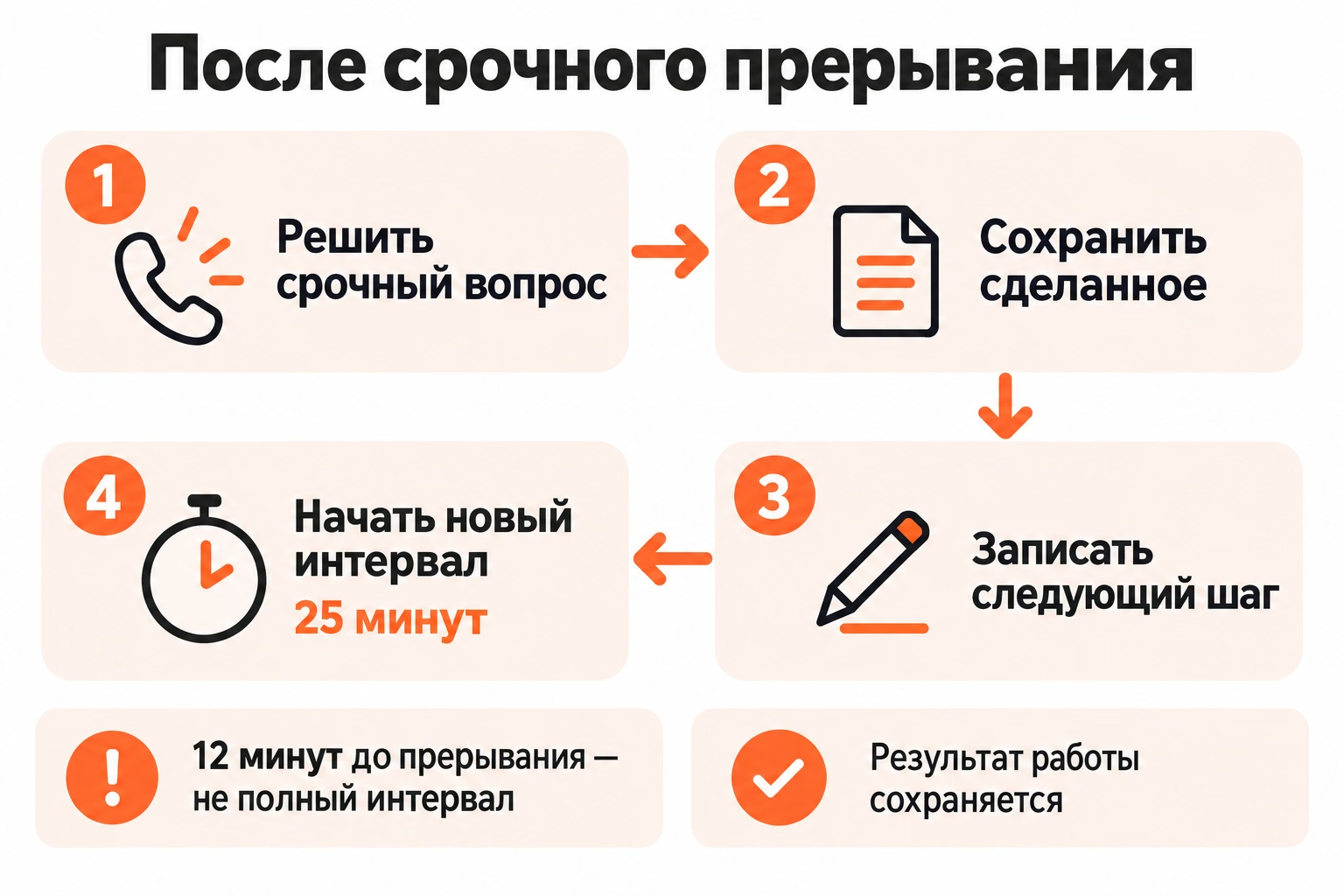
What to do after an urgent interruption
First, handle the urgent situation, then save what has already been done and write down the point from which you need to continue working.
Imagine that in the twelfth minute of preparation of the letter received an urgent call on the current delivery. Before switching, a short recording remains:
Ready: Price and timing questions.
Stopped: formulation of the question of delivery.
Next step: Check the minimum amount in the offer.
Interruption: emergency call from the supplier.
In a strict indivisible interval scheme, this approach is not counted as complete. A new 25-minute stretch begins after returning to focused work.
The result of the first twelve minutes is saved: the written text and the data found do not disappear. Only the full interval is not counted.
The pause of the timer with the subsequent addition of individual segments refers to another method of accounting. Mixing the two rules makes the number of intervals incomparable.
How to evaluate the result of the work on timer
After the approach, write down the initial estimate, full intervals, interruptions, actual result, and next step. This record separates the time spent from the readiness of the task itself.
For our example, the result looks like this:
The interrupted approach is recorded separately:
The number of full intervals shows the number of focus approaches, not the value of the result. Five intervals do not make a task more useful than one that requires one.
Formula 25 minutes × number of full intervals It also doesn’t show all the time. It does not include breaks, preparation of materials and forced interruptions.
Comparing plan and fact is more useful for similar tasks. After a few emails, you’ll see how realistic one-size-fits-all is and at what stages more time is needed.
How to continue an unfinished task
Before rest, write down the stopping place and one specific action to continue. After a break, return to the same job until your priority has changed.
For a letter to the supplier, a record is enough:
The next step is to check the delivery terms in the original sentence and add the question to the draft.
This formulation retains the working context. After a break, you do not have to re-read the entire document and look for a stop.
With external dependence, the state of the task changes. The letter has already been sent, and further work depends on the response of the supplier - a condition for continuation appears in the record: We are waiting for the answer with the price until September 14..
Getting back to work helps limit: The next focal length continues the movement of one task instead of running several unfinished tasks simultaneously.
When timer work gets in the way
Hard intervals interfere when operating conditions do not allow to protect the selected segment or the signal regularly breaks steady immersion. In such conditions, the duration of the approach is changed or the timer is abandoned.
Applicability depends on the specific task and working conditions, not the profession. One specialist uses short intervals to process mail, but saves long blocks for complex analytical work.
Twenty-five minutes is the rule of Pomodoro's basic scheme, not the proven limit of human concentration. It is not necessary to adjust the whole working day to one rhythm.
How to check a different rhythm of work
In advance, set a new duration and compare several similar working approaches on the same grounds.
For example:
40 minutes of work for 10 minutes of rest.
After several approaches, compare:
- How quickly did you get to the task?
- What results are obtained for the working block;
- how many forced switches occurred;
- Is it easy to restore context after rest?
- Whether the signal interfered with the continuation of work.
The 40/10 rhythm is a personal experiment. It does not belong to the classical scheme and is not a universal optimum.
The timer is completely abandoned when protection of intervals is impossible or the countdown itself begins to require excessive attention. The priority of the task, its state and the recorded continuation point remain useful regardless of how the time is organized.
How to connect work intervals with a kanban board
The Kanban board stores the state of the task and the working context, and a separate timer sets the boundary of the focus approach. A completed interval by itself does not translate a task into a finished result.
For a training example, we set four states:
Planned → In work → Waiting → Ready.
Create one card. “Prepare a letter to the supplier”. In the description, we fix the result criterion, materials and preliminary assessment:
Result: A draft letter with questions about price, timing and delivery.
Score: 1 interval.
Materials: Supplier's offer.
Fact:
Next step:
After the start of a separate timer, the card is in “In Work”. The first full interval ends with this record:
Fact: 1 full interval.
Result: questions on price and timing are ready, the issue of delivery requires clarification.
The next step is to check the delivery terms in the original offer.
The card remains in the “In Work” because the result criterion has not yet been met. After preparing and sending the letter, further action depends on the supplier - the card goes to "Waiting" with a specific condition of return. In "Ready" it falls after the result, and not after a set number of intervals.
In Kanbano, the number and names of the columns are set for the workflow, and the card stores the description, date, marks, status, checklist and attachments. The timer in this scheme remains a separate tool, and the fact of the approach is recorded manually.
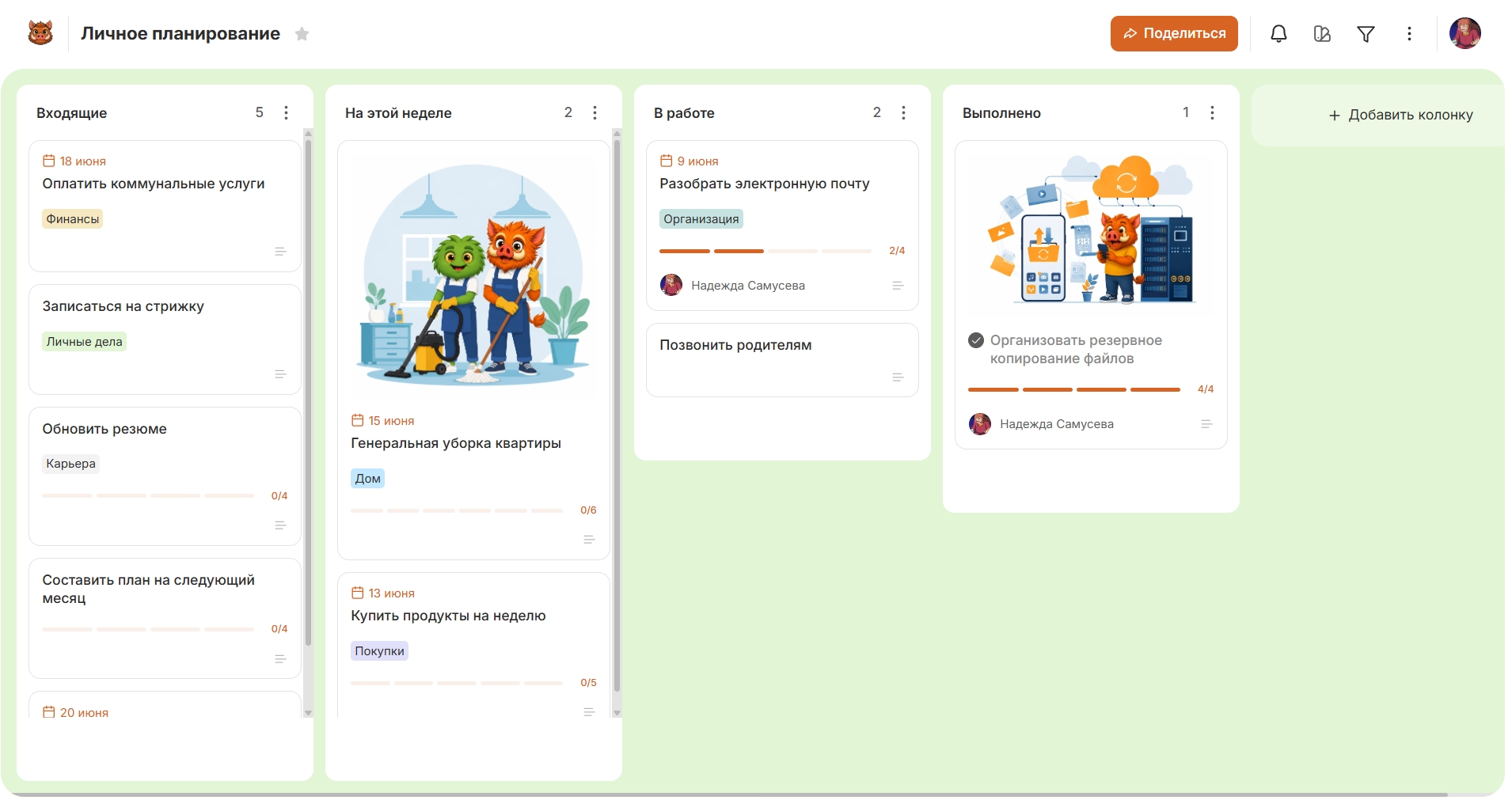
When choosing a tool board For such a scenario, a specific criterion helps: the task must preserve the materials, the actual result and the point of return between the individual working approaches.
A separate card is not required for each interval. One task takes as many approaches as its result requires. To repeat the scheme at your own work is enough carry on On the board, write down the readiness criterion and the score, and then conduct the first focal interval.