Parkinson's Law describes the observation that work expands and takes up the time it takes. A weekly report, designed for two hours, can stretch for the whole day, if left under it all day. The formulation appeared in Cyril Northcote Parkinson's 1955 satirical essay and is not a physical law.
The practical meaning of the principle is to check whether a particular task really needs all the available time. To do this, take one repeatable low-risk work, perform it twice according to the same quality criterion and compare the time spent, alterations and the result. We will not reduce the term blindly: first we will determine the mandatory result, then we will remove only the extra time.
What does Parkinson's law mean?
Parkinson’s law means that the time available affects the amount of time a person spends on a task, even if the mandatory result is unchanged.
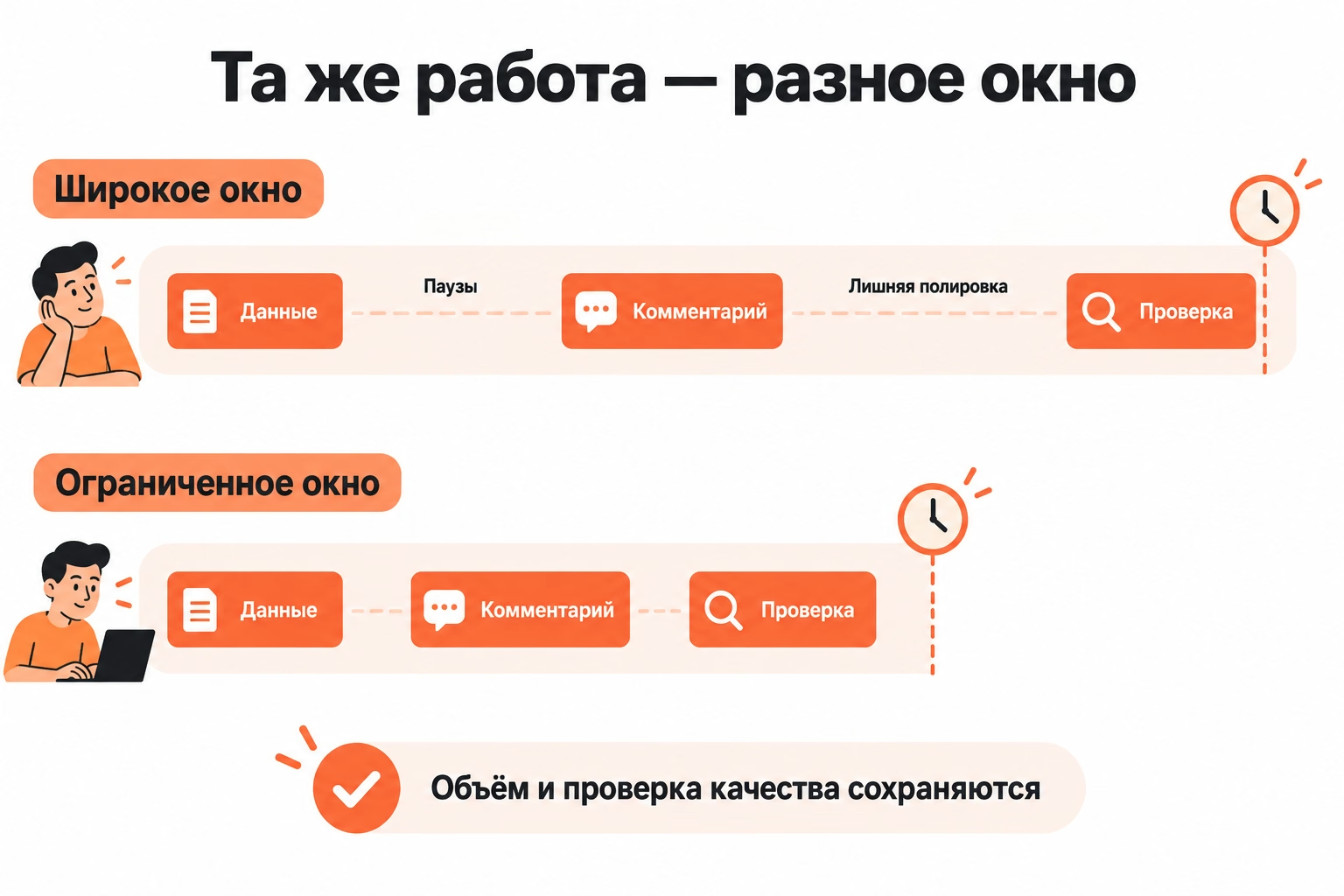
Let’s present a weekly summary of three parts: collect indicators, prepare a short comment and check the numbers. Left to work all day. Data collection begins later, there are additional pauses between the stages, and the finished text is edited several times without changing the content.
With a narrower working window, the composition of the summary remains the same: the same indicators, the same comment and the same check. The comparison does not show the “right” number of hours, but how the available time affects a particular repeatable process.
Not every increase is due to Parkinson’s law. Work takes longer because of new information, incorrect initial assessment, missing raw data, or external dependency. Such reasons should be separated from stretching an already understandable task.
Where did the wording come from?
The wording of the first law was proposed by British historian and publicist Cyril Northcote Parkinson in an essay for The Economist in 1955. The satirical text described the expansion of bureaucratic work along with available resources and time.
Later, the name Parkinson began to be associated with other laws and statements. In this article, we consider only the first law - the expansion of work to the time available for its implementation.
Why the task fills the available time
The work is stretched by a late start, a blurred completion criterion, and additional actions that barely change the mandatory outcome.
The first mechanism is a late start. A distant border does not require immediate action, so the performer first switches to other cases. The main work is moving closer to the deadline, although its actual volume has not changed.
The second mechanism is the indefinite completion point. A person continues to collect data, rewrite text, or look for new options because the “ready” state is not fixed in advance.
The third mechanism is excessive polishing. The result already meets the requirements, but free time is filled with small improvements without a noticeable impact on the outcome.
A similar effect occurs in meetings. An hour-long meeting takes an hour, although key decisions have been made earlier. The shortening of the meeting in itself does not solve the problem: first you need to determine the result and the list of issues.
How a blurred result stretches the job
A blurred result stretches the job because the performer doesn’t see the boundary between the mandatory part of the task and additional improvements.
Formulation “Prepare a good weekly report” It doesn't set a stopping point. It’s easy to add another schedule, a new check, or an additional comment.
The specific criterion is different:
The summary contains weekly figures, comments on the three main deviations and verified final values.
Repetitive work requires advance specifyThe same boundary allows you to compare two passes, rather than two different tasks.
When improvements stop changing results
Additional improvements cease to change the result when the mandatory criterion has already been met, and new actions do not affect the decision of the recipient.
The summary meets the requirements. The next twenty minutes are spent reshuffling paragraphs, replacing a few wordings, and designs that do not change the meaning or accuracy of the data.
Quality check does not apply to excessive polishing. Verification of numbers, mandatory editing and correction of errors are included in the criteria of readiness.
Boundary is especially important when working without a formal receiver. The weaker the “ready” state is defined, the more space remains for optional actions.
How to Check the Law on Your Task
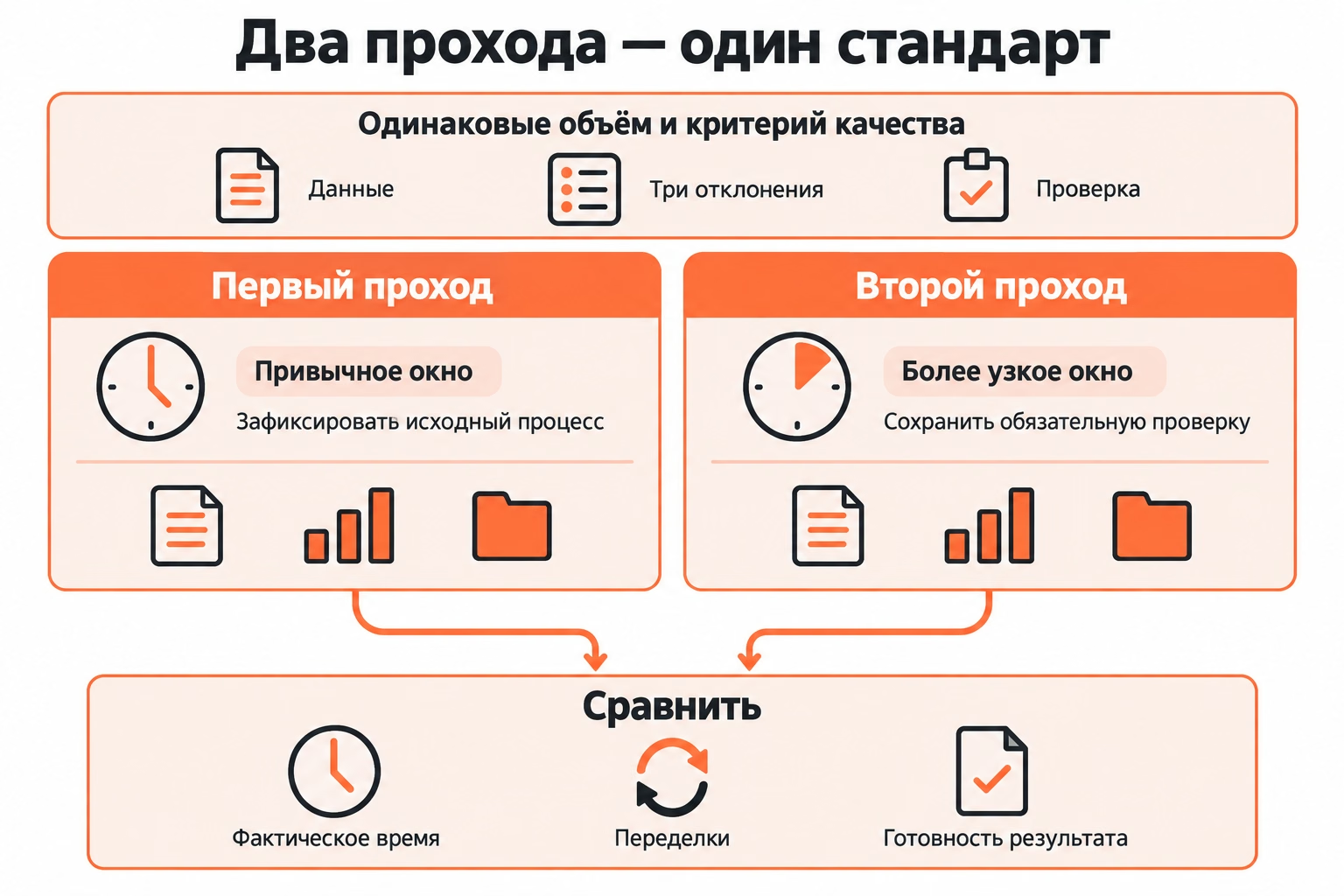
Conduct two comparable passes of a repeatable low-risk task: first fix the usual actual time, then reduce the free window with the same result criteria.
In our example, the first pass of the weekly summary is performed in the usual mode. The contractor records the start and end time, significant interruptions, the number of corrections after the inspection and the final result.
Before the second passage, the same composition of work remains:
- collect the same set of indicators;
- explain the three main deviations;
- check the final values;
- prepare a document in the same format.
Only the available window changes. Comparing a three-indicator report with a ten-part report will show nothing: the workload has changed along with the deadline.
How to Choose a Safe Task
For the experiment, choose repeatable, reversible and low-risk work, where a small error does not create serious consequences.
Suitable:
- internal weekly report;
- draft of the regular report;
- preparation of materials for an internal meeting;
- A breakdown of accumulated notes.
The experiment is not conducted on legal documents, payments, medical decisions, security-related activities, or obligations to a client with a fixed standard.
The work limitation checks the time consumption, rather than allowing mandatory quality to be reduced.
How to fix the initial time
The first pass captures the actual process without artificially shortening the term.
Write it down:
- start time;
- completion time;
- significant interruptions;
- mandatory result;
- number of alterations;
- comments after checking.
One pass does not set the standard for all the following tasks. It is needed as a starting point for a comparable second execution.
The reasons for delays are also recorded separately. Waiting for data from a colleague and twenty minutes of additional editing increases the total time for a variety of reasons.
What to consider the finished result
Ready is the result that meets the predetermined requirements and passed the mandatory quality check.
To summarize the criterion set before the second pass:
Data collected in full, three major deviations explained, the final values checked, the document is ready to send.
A shortened window does not change this standard. Time is compared with the same state of the result.
Before the experiment, the team target with available resources and commitments. Restrictions should not turn a working experiment into a hidden risk of failure of the real term.
How to reduce time without loss of quality
Reduce only the available margin between the necessary actions, keeping the required result, check and time for known risks.
Let's say the first pass of the summary took four hours. Two hours were spent on collection and analysis, 30 minutes were spent on mandatory inspection, the remaining time was divided between late start, switches and additional editing.
The second pass gets a narrower window, but the mandatory check remains.
How to Set a Work Limitation
A work constraint sets a specific window on a task, but does not translate into an external promise to complete the result at any cost.
The first pass of the summary took four hours. For the second performer, three hours are allocated with the same composition and quality criteria. Three hours refer only to a training example: there is no universal reduction rate.
Timeboxing, or timeboxing, sets a limited period for a particular job. Deadline sets the moment for which the result should be ready. These boundaries solve different problems.
When to break down work into stages
Break down the work into stages where a single time limit does not show the source of overspending.
The summary is divided into three parts:
- data collection;
- draft preparation;
- check.
Each stage has its own completion point. Data collection ends after obtaining mandatory indicators, draft - after explaining three deviations, verification - after reconciliation of the final values.
Intermediate points show exactly where the work is stretched. The reason may not be in the whole task, but only in the additional editing of the last stage.
How much reserve to keep
The size of the reserve depends on the known risks of a particular task, so there is no universal percentage.
A reserve is needed in case of uncertainty: data delay, mandatory coordination or a technical operation with an unpredictable duration.
Wide window and reserve perform different functions. A wide window simply gives the task extra time. The reserve is associated with a specific risk and is used when it occurs.
Planning the day helps reserve separate from the time of the experiment. An urgent call or delay incoming data in this case is not confused with the actual duration of the main work.
How to run an experiment on a kanban board
On the kanban board, record two passes, the readiness criterion, the time limit and the actual result. Time, alterations and causes of deviations are entered manually.
The learning flow looks like this:
Planned → In work → Testing → Ready.
For the experiment, two comparable cards or one card with two lines of observations are created. The first option separates the passes, the second stores both results side by side.
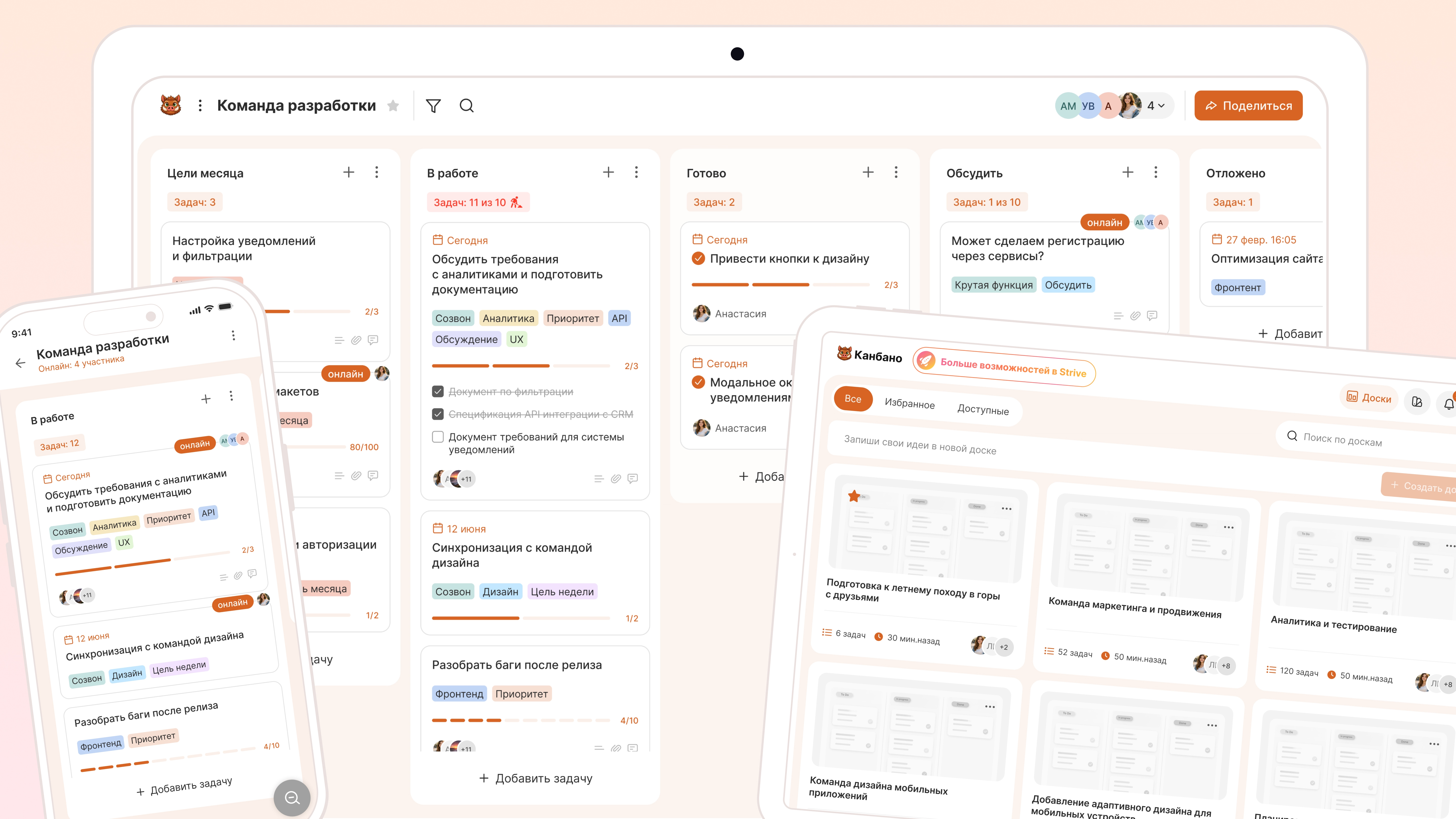
In Kanbano, the user adjusts the number and names of the speakers. The card stores the description, performer, date, marks, status, checklist and attachments. The user fixes the actual time manually: the built-in time tracker, automatic WIP limit and cycle time report are not included in the confirmed feature set.
What to write in the card
The experiment card should store data on which the two passes are compared after completion.

For the summary, record:
- task;
- criterion of readiness;
- available window;
- actual time;
- substantial alterations;
- causes of interruptions;
- result of the inspection.
The "Experiment" label separates such cards from normal work. The very method of execution from the presence of a label does not change.
How to limit current work
During the experiment, leave one active card and do not start new non-urgent tasks before the current pass is completed.
Simultaneous work on a summary, writing, and teaching assignment distorts measurement: actual time involves switching between different contexts.
The one active card rule helps reduce. Software locking is not required: the user manually holds the experimental task in operation and separately records the mandatory interrupts.
How to compare results
Compare the actual time, the readiness of the result, the number of alterations and the impact of external interruptions.
Reducing time does not mean improving in itself. The second pass shows a useful result only while maintaining the mandatory quality and an acceptable volume of alterations.
When a short term is harmful to work
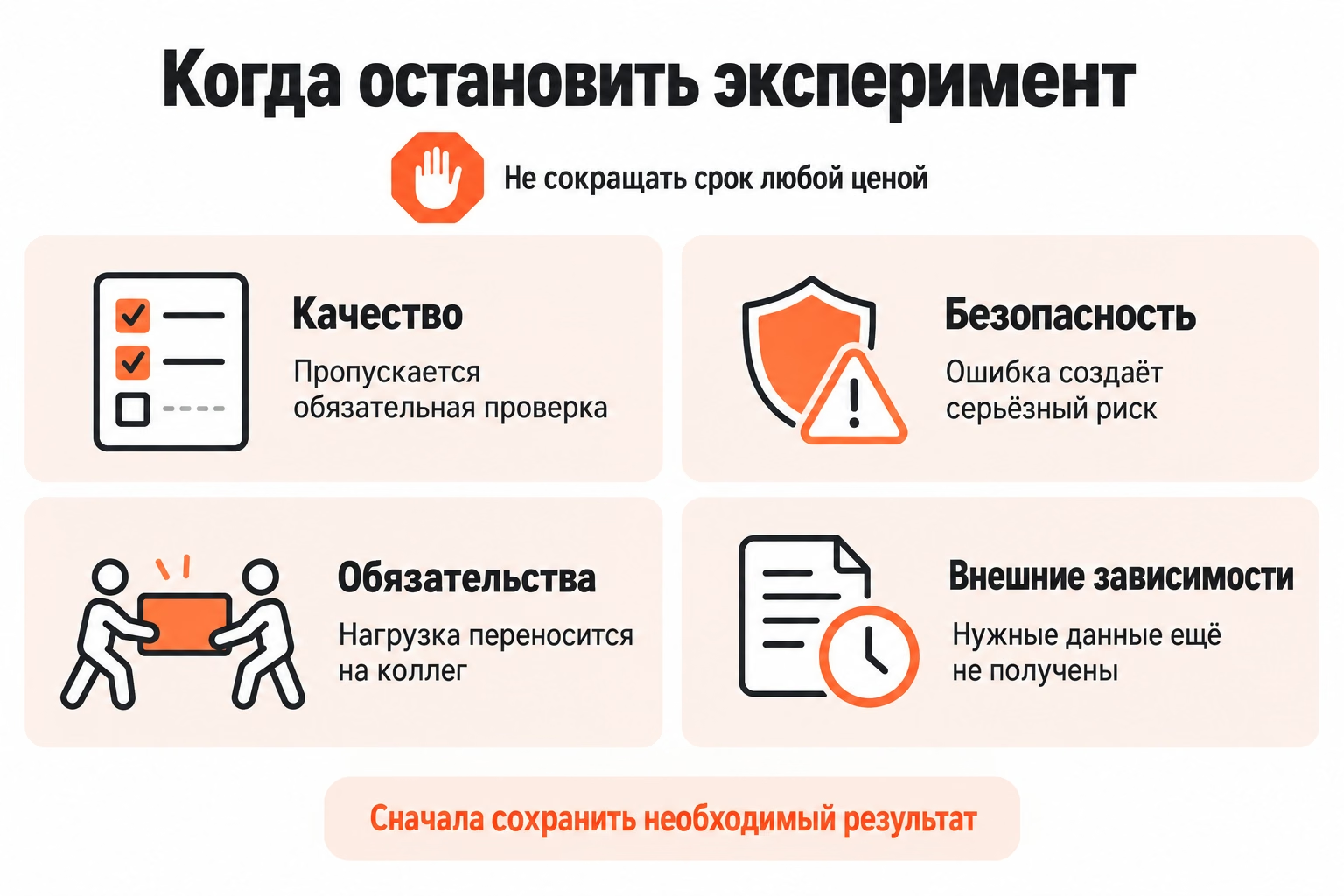
A short restriction is terminated if it impairs safety, mandatory quality or the ability to verify the result.
Parkinson’s Law doesn’t require turning every task into a clock race. Creative work, learning, research, and tasks with high uncertainty require space to search, test hypotheses, and discover new information.
Stop signals appear when the performer:
- omits mandatory inspection;
- hides the unfinished part;
- shifts the burden on colleagues;
- ignores external dependence;
- It brings inevitable changes beyond measurement.
Working in short intervals requires first work-rate. The Parkinson's Law experiment tests another -- the common window available to the task.
What tasks cannot be accelerated blindly
Do not shorten your time without making a separate assessment on tasks where a mistake creates significant financial, legal, medical, or security implications.
Verification of the contract, payment, change of access to the system or obligation to the client require preservation of all the stipulated stages.
High uncertainty also makes the comparison weak. Research on an unfamiliar topic cannot be measured according to the same pattern as a regular weekly summary: the amount of work required is much less well known in advance.
How to Consider External Dependencies
Separate your work from the expectation of external results.
The report can take all day because of the data that a colleague sent only in the evening. Reducing the personal working window will not eliminate this delay.
The record shares two meanings:
My own work is 2 hours 20 minutes.
Data waiting 3 hours.
Separation does not allow Parkinson's law to attribute a delay that the performer did not manage.
When to stop the experiment
Stop the experiment if the mandatory result worsens, significant changes increase or there is a risk for which the working window cannot be reduced.
After two comparable passes, three solutions remain:
- maintain the restriction if the mandatory quality is preserved and the unnecessary actions disappear;
- ease the restriction if there was not enough time for the required amount of work;
- revoke the restriction if the process requires a longer period of time or depends on external conditions.
Parkinson’s law is not for continuous acceleration, but for testing a specific question: does the task really require all available time? The next step is check out Another comparable pass with the same result criterion and a separate fixation of actual time.