The error in goal formulation is repeated in tasks, deadlines and reports. The team begins work, and after a few days finds out that the participants have different understanding of the result, the date is chosen without calculation or the execution depends on the person who did not confirm the participation.
Before launching, the goal is useful to conduct through seven checks: determine the owner and the desired result, set the completion criterion, justify the deadline, find restrictions, check the conflict with other obligations and highlight the first stage. Let's analyze the tests for one purpose - to prepare a knowledge base for support. A full goal-setting cycle will come in handy earlier when you first need to stageAnd here we are already working with a ready draft of the goal.
How to start a goal check
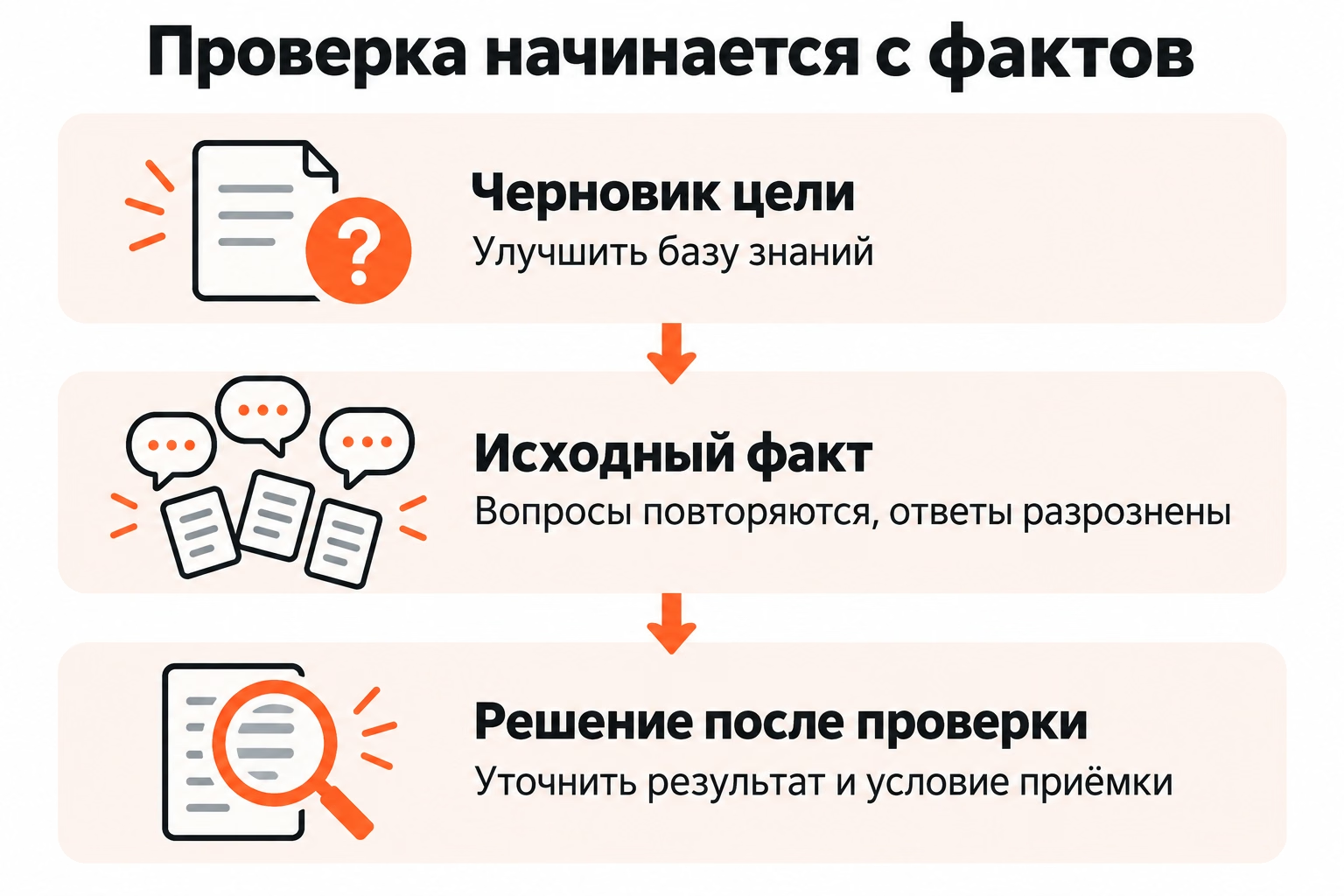
Start with the current wording, the reasons for its occurrence and the fact that describes the situation before starting work. You do not need to rewrite the goal at once: first you need to understand what problem it should solve.
Draft wording of the support team:
Improve the knowledge base.
The direction is clear, but the information is not enough to start the work. It is unclear what exactly needs improvement, who accepts the result, and what data the team decided to change the base.
The test begins with three facts:
- who expects change;
- What is the current problem?
- Where did the data on the problem come from?
The support team regularly answers the same questions, and ready answers are stored in correspondence and personal notes of employees. Repetitive appeals and disparate materials provide a starting point for further solution.
Whose goal is it?
The goal should have a specific owner of the result and understandable participants in the work.
A phrase The manager asked to improve the knowledge base. Describes the source of the request, but not the responsibility for the outcome. The team is still unclear who determines the volume, accepts the result and resolves controversial issues.
In a training example, the support leader becomes the owner. Experts participate in the verification of materials, the authors prepare answers, and the owner makes the final decision on the stage.
The absence of an owner creates a simple risk: the work moves, but different participants use different criteria of readiness.
What results are needed
The result should describe the state that will appear after the work is completed.
A phrase “Improving the knowledge base” It sets the direction. A more precise boundary is required:
By November 30, take 40 responses to recurring support questions. Each response is checked by a designated expert.
The number and date refer to the study example. The main difference is not in the numbers, but in the testable result: instead of an abstract improvement, a specific set of accepted materials appears.
How to check the wording of the goal
Check whether the goal contains one result, a clear completion criterion, and a source of fact. Several changes in one wording make it difficult to assess the result and blur the responsibility.
For a knowledge base, the typical mistakes are:
SMART refers to ways of verifying wording, but does not require repeating the method. The task of the stage is to find a specific defect of the target already selected.
Is there one result?
One goal should lead to one major change, which is verified separately.
Formulation Take 40 responses and reduce the number of calls It combines content creation and changing customer behavior. Reducing requests depends not only on materials: navigation, search, composition of requests and support work affect.
To start, we leave one result:
Take 40 responses to recurring support questions.
Changing the number of requests, if necessary, becomes a separate check with its data source.
Confirmation of completion
Completion must be supported by a specific fact, not by the performer’s subjective feeling.
For the knowledge base, the source is a list of materials with the status of expert verification. The written text is not yet included in the final volume until the appointed expert has confirmed it.
Difficult acceptance requires advance checklist mandatory conditions. In our example, the rule is shorter: the answer is taken into account only after expert confirmation.
The source of the fact is better to determine before the start. Otherwise, the participants will first do the work, and then begin to argue which materials are considered complete.
How to Check the Target Term
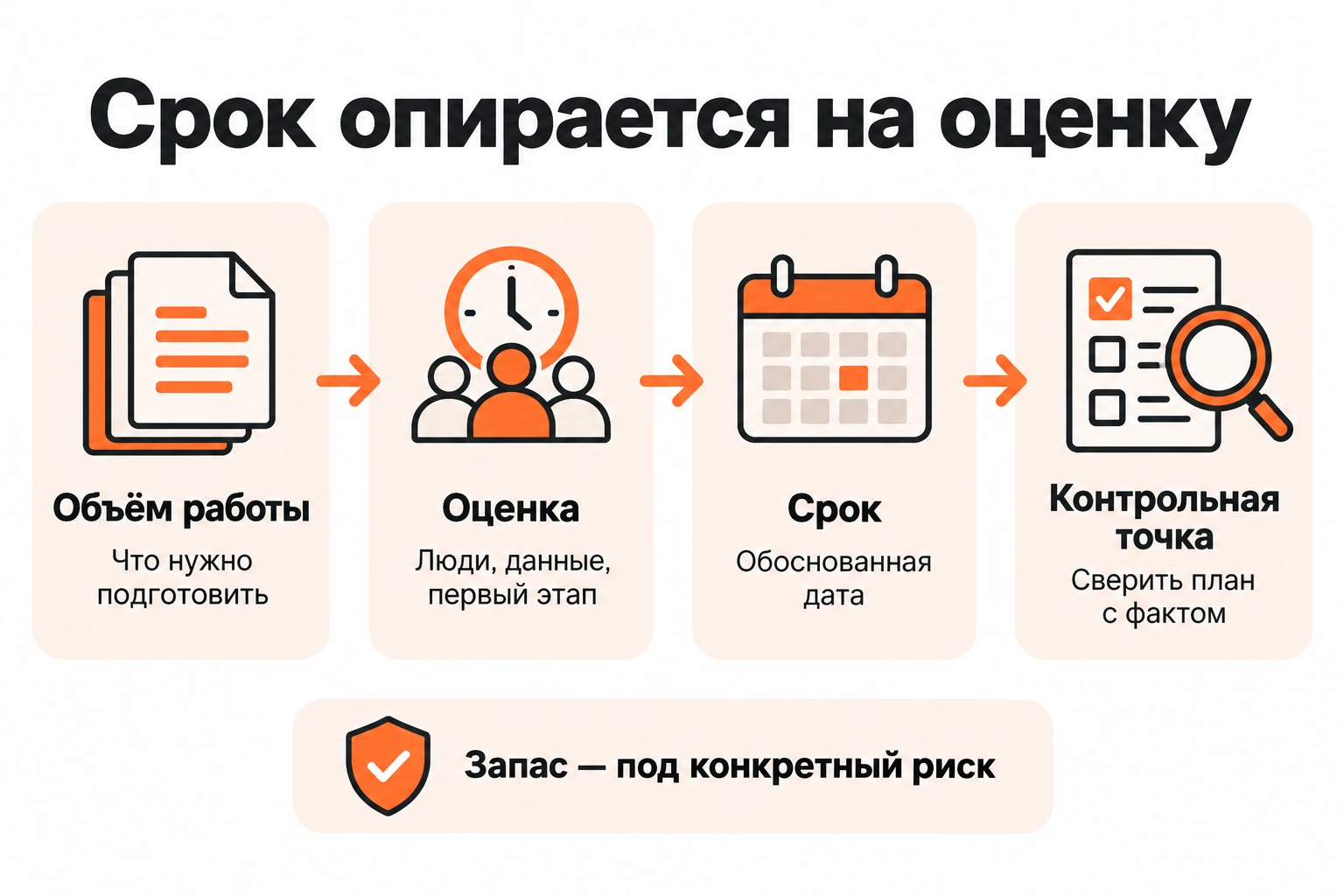
The deadline is checked through the amount of work, the availability of participants, the actual speed of the first stage and the employment of the necessary resources. The date itself does not prove that the result is achievable in the selected period.
The date of November 30th requires some initial data:
- How many answers already exist;
- How many materials need to be prepared from scratch;
- who writes the texts;
- Who checks them?
- How long does the first inspection take?
- What other obligations are used by the same professionals?
The term becomes the working limit after comparing these conditions.
What the evaluation is based on
The assessment should be based on its own workload and data from the next stage.
The team first prepares five answers. The first small package shows the actual time to search for questions, write, agree and correct.
The data obtained help to estimate the remaining work more accurately than the date chosen only for the sake of accurate wording.
The timing of another project is not a sufficient basis either. In the next team, there are different people, materials, loading and verification procedures.
When you need a temporary supply
Time reserve is required for a specific uncertainty that cannot be eliminated before the start.
For example, an expert checks materials between other work tasks. The plan separately takes into account the possible delay in harmonization.
The stock does not need to be hidden inside the inflated period of each action. This approach makes it difficult to distinguish the actual duration of work from the time left at risk.
After determining the general boundary, first-step in the real load of the day. A long-term goal does not become a daily list.
How to Find Hidden Limitations
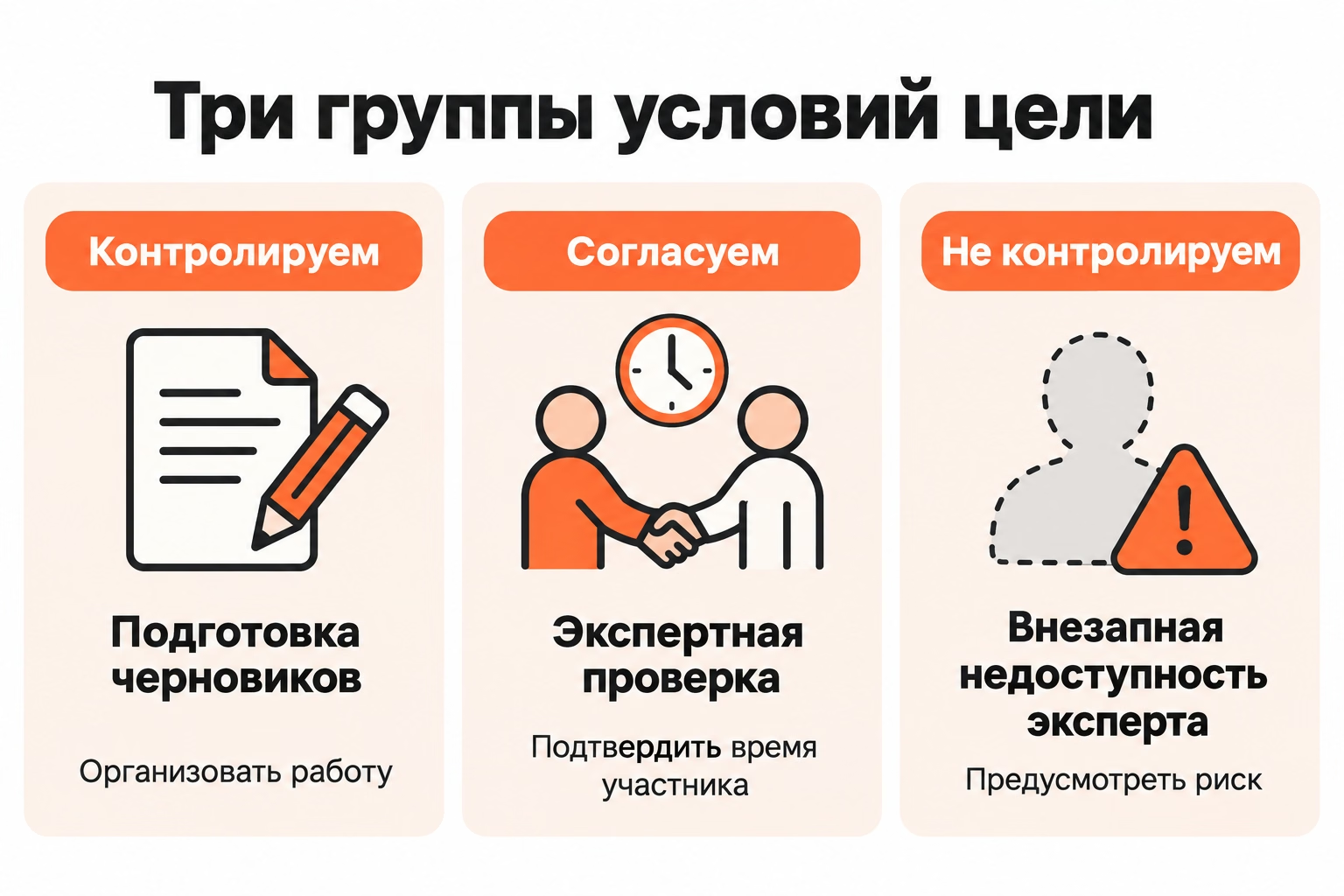
Divide the terms of the target into three groups: the team controls them directly, agrees with other people, or does not control them. This separation indicates where action, agreement, or decision to delay launch is required.
For the knowledge base, the distribution looks like this:
- preparation of drafts is within the control of the team;
- expert verification requires approval;
- The sudden inaccessibility of the expert is not under direct control.
Mixing these factors leads to a false assessment of achievability. The contractor is responsible even for conditions that he does not manage.
What depends on other people
External participation must be confirmed before work begins.
Let’s say that one expert has to check all the materials, but in the next month is engaged in another project. Having an expert in a plan does not mean having time.
The team chooses a specific solution:
- agree on the time for verification;
- connect a second specialist;
- reduce the first stage;
- reschedule.
The person responsible for the goal does not have to perform each stage on his own. His task is to see critical dependencies and get agreements before work accumulates in front of an inaccessible participant.
What resources are lacking
The missing resource should be specifically identified.
A phrase "lack of resources" It doesn't set action. Formulation To check the first five answers, you need a support expert two hours to Friday. It already shows the deficit and the starting condition.
Resources include specialist time, raw data, access, materials and budget. Critical scarcity affects the volume, date, or launch decision.
How to resolve conflict goals
Comparison competing goals by outcome, timing, delay consequences, and overall limited resource. Two “high priority” labels do not eliminate conflict.
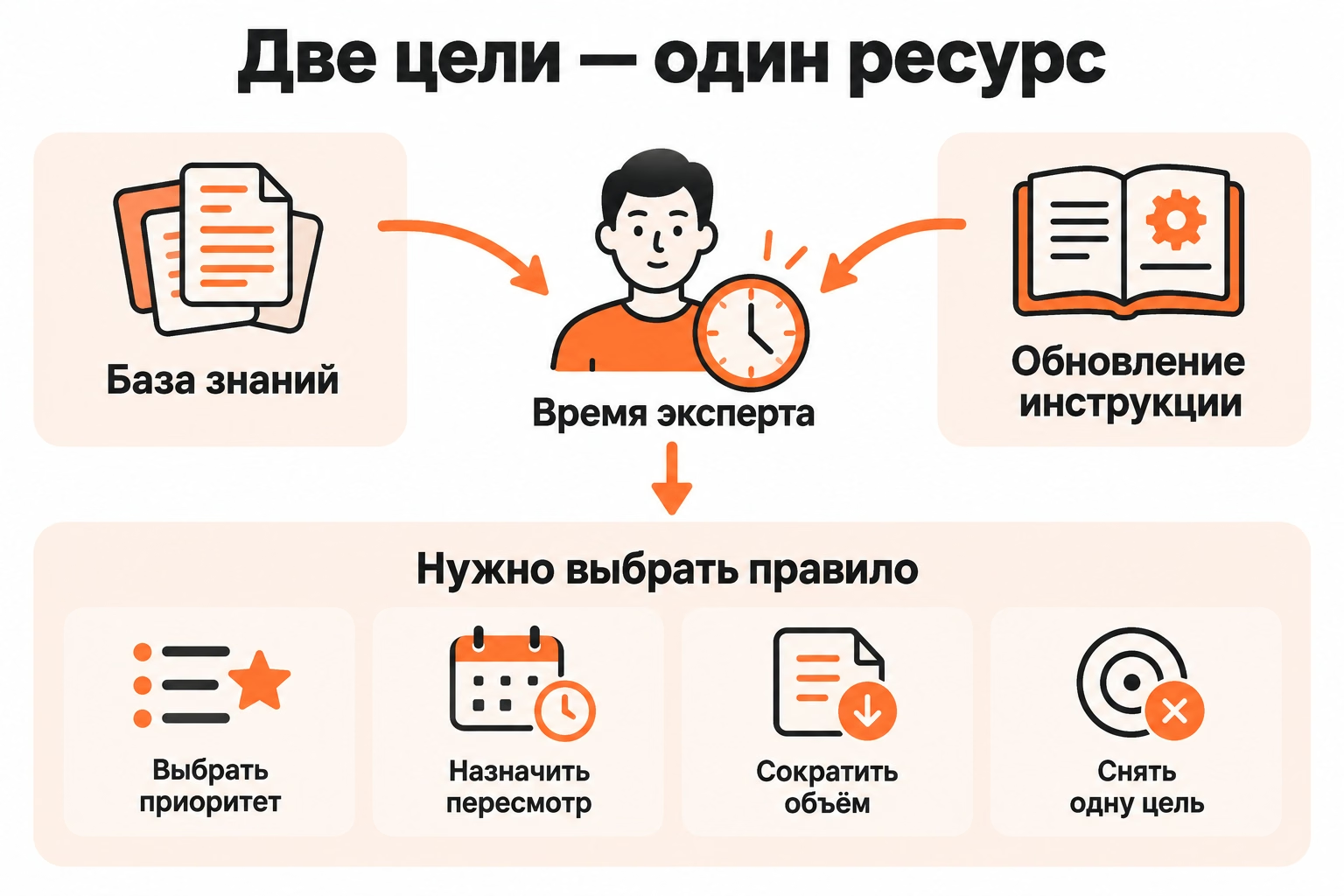
Let’s say one expert is needed for both the knowledge base and the instruction update after a product change. To perform two checks in parallel without affecting the timing will not work.
The team chooses one rule:
- One target receives an active resource;
- the second receives the date of revision;
- The volume of the second result is reduced;
- One of the targets is off.
More important now.
Priority is given to the goal, the delay of which creates more serious consequences in the current conditions.
Updating the instructions is higher if the old version already contains incorrect information for customers. Work on the knowledge base is maintained, but gets a new launch point.
Once the goal is selected, it makes sense. priority individual tasks. The order of the cards helps to execute the decision, but does not replace the choice between conflicting results.
How to remove excess results
Remove from the current launch the result that is not necessary to achieve the main goal.
The team simultaneously planned to prepare answers, completely rebuild the knowledge base and change the design of the section. One launch combines three independent results and competes with itself over time.
The first stage leaves the preparation and acceptance of materials. The new structure and design receive a separate solution after checking the content.
Reducing volume does not mean reducing quality. It separates the mandatory result from the work that can be done later.
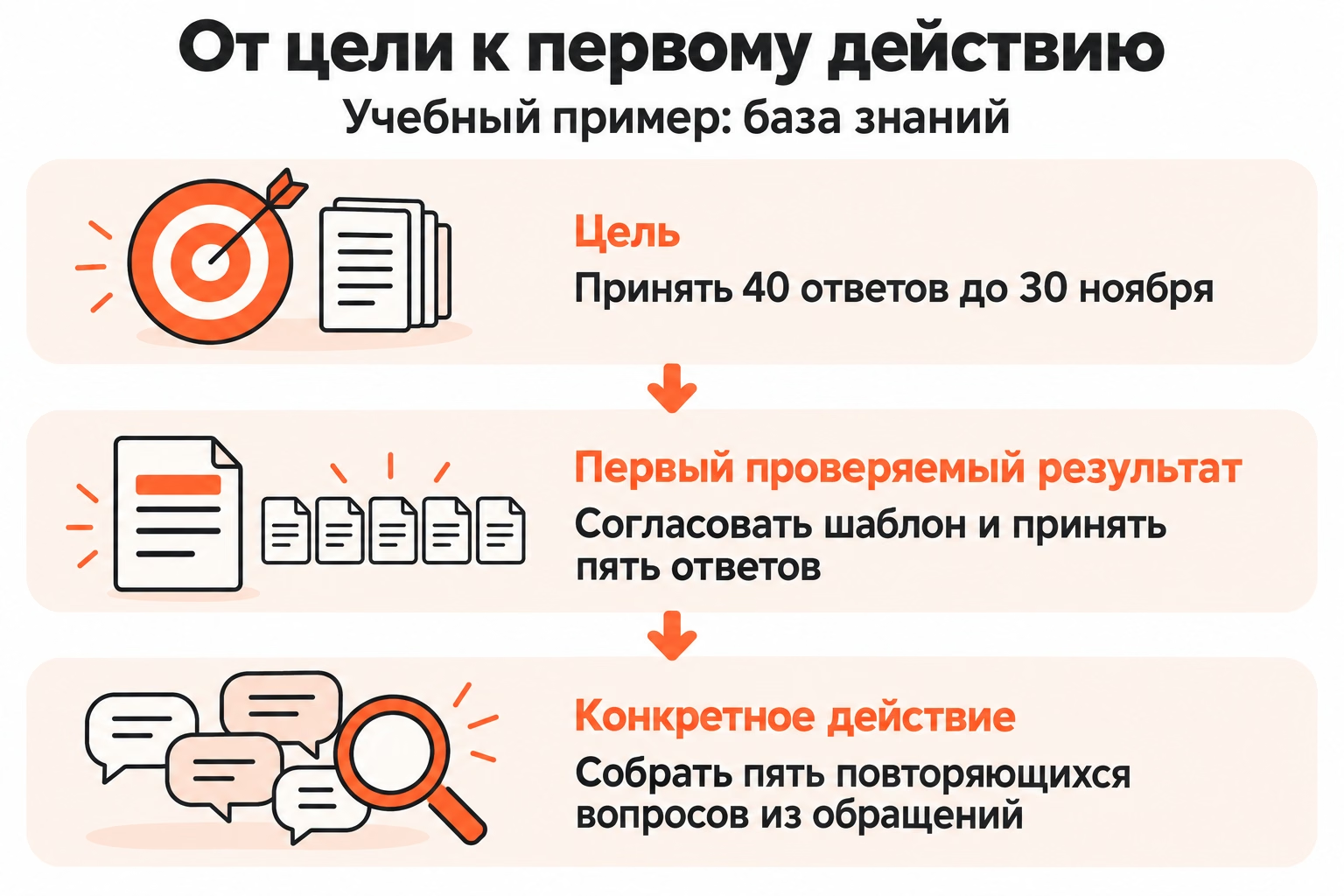
How to prepare the first stage
Highlight the nearest verifiable result and the first action that begins without further discussion.
For the knowledge base, the first stage looks like this:
Agree on the template and accept the first five answers.
First action:
Collect five recurring questions from support messages.
The small stage checks the initial assumptions before the big run: is there enough data, is the template suitable, is an expert available and how long it takes one training cycle.
What fact do you need first?
The first step is to provide data that will influence the decision.
The five responses adopted indicated:
- How long does the preparation take?
- how many changes the expert returns;
- Whether there are enough raw materials;
- whether the chosen template works;
- Checking is available at the right pace.
The team gets real data before scaling the work to the remaining volume.
How to Choose a First Action
The first action must begin without additional choice.
A phrase “Begin work on the knowledge base” It doesn't set an object. The artist will again have to decide which materials to take first and where to look for questions.
Formulation Collect five recurring questions from appeals over the past week contains the source, volume and specific action.
After completion, the following work becomes clear - to prepare drafts on the selected issues.
How to check before the start
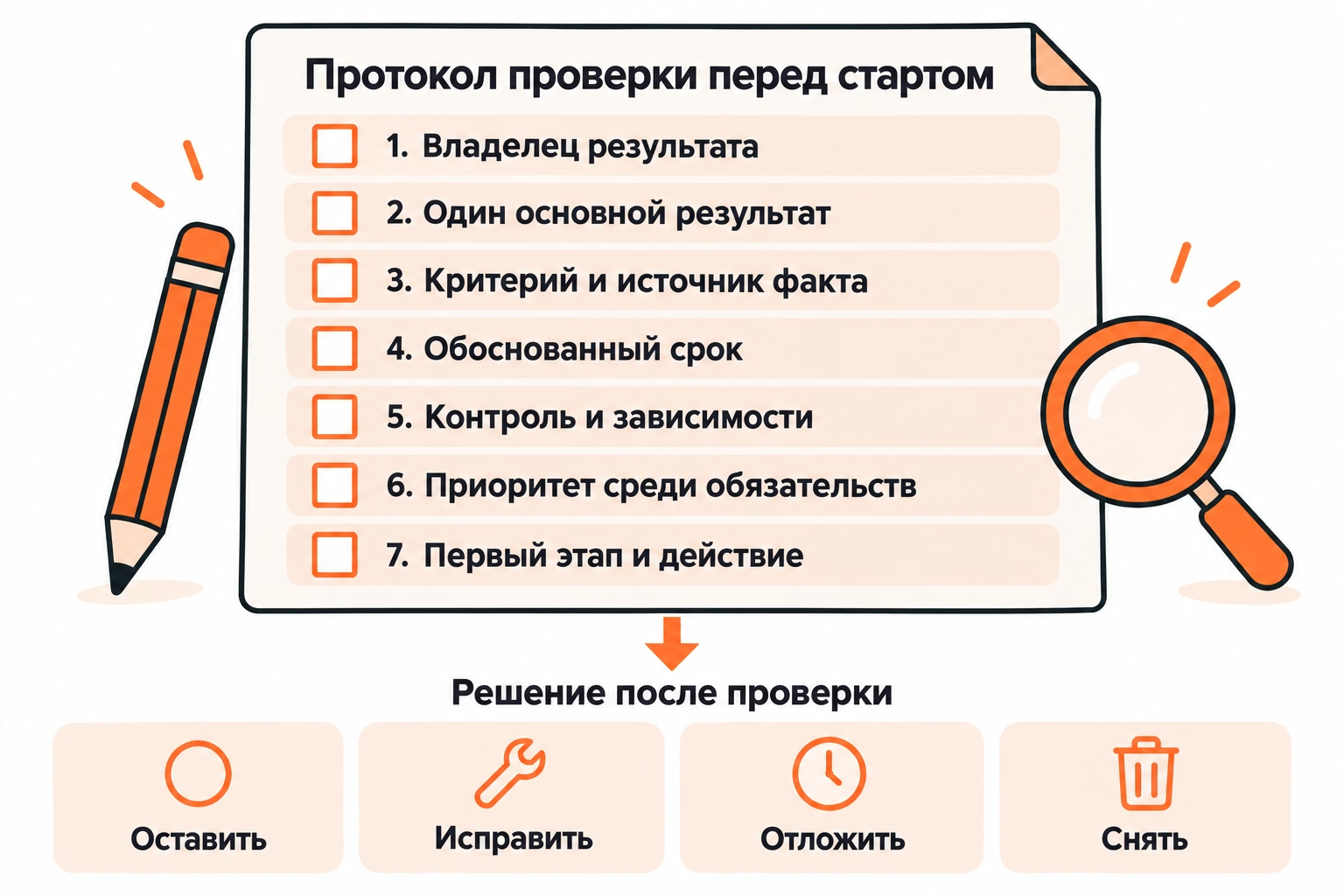
Before launching, run the target through seven checks and make one of four decisions: leave, fix, postpone or withdraw.
The goal is ready to go when the team answers seven questions:
- Whose purpose? The owner of the result is clear.
- What results are needed One major change has been formulated.
- Confirmation of completion The criterion and the source of the fact.
- What the term is based on Date is related to volume, resources and dependencies.
- What the team controls External conditions and participants are named.
- What conflicts with purpose Priority is defined over other obligations.
- Where does work begin? The next step and the first action are identified.
After diagnosis, the educational goal looks like this:
By November 30, take 40 responses to recurring support questions. Each response is checked by a designated expert. The first step is to take five responses to an agreed template. The work begins after the time of the expert is confirmed.
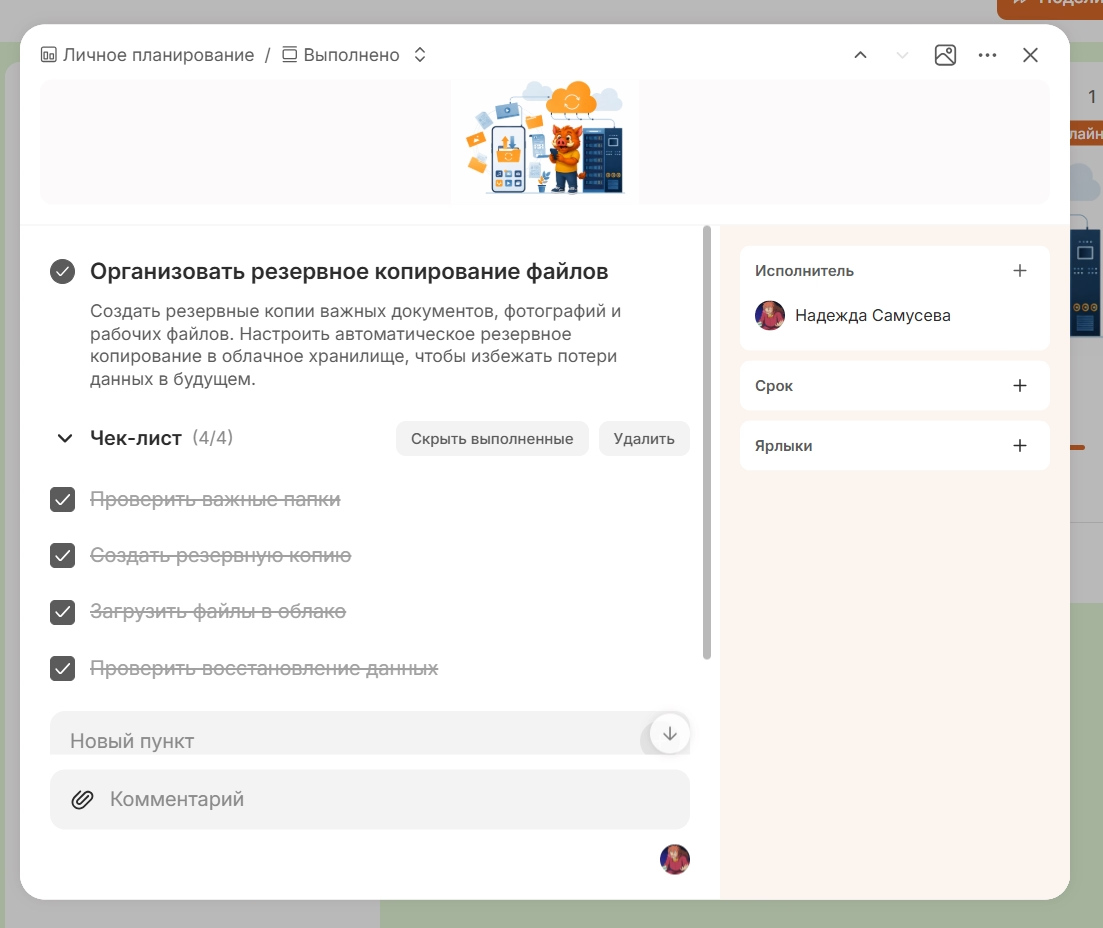
The card on the board stores the wording, term, responsible and context of the decision. In Kanbano, the work card contains a description, performer, date, labels, status, checklist and attachments. The user calls the columns by their own stages of work. This scheme does not require specialized automatic target verification.
What to correct in wording
Correct a specific defect found during the inspection.
Several results are shared. A vague criterion is replaced by an observed fact. Unreasonable deadline is recalculated. An unavailable resource changes the volume or date. The conflict of goals requires the choice of priority.
After correction, it is important link with current commitments and available time. Even accurate wording does not automatically receive a resource.
When the goal is postponed
Delay the goal if the result remains necessary, but there is no critical condition for the start.
For the knowledge base, this condition is the inaccessibility of the expert. Running a large volume of texts before the agreement on verification will create a queue of drafts without a clear path to the finished result.
The goal is removed completely when the need has disappeared. The deferred purpose retains the reason for the return and the specific condition of the review.
After seven inspections, it is enough. target On one card, fix the first stage and only then create work tasks.