Habit tracker is a tool for fixing repetitions of one action for a selected period. Each mark refers to a specific date and shows the actual result: the action was performed, missed or not planned. The history of marks reflects the frequency of repetitions, but does not prove automatic habit formation.
Let's take a one-week manual. As an example, take reading 10 minutes after dinner on Mondays, Wednesdays and Fridays, prepare individual cards for scheduled dates, fix the omission and additional execution, and then adjust the next period.
How to choose an action for regular accounting
Start with one small, repeatable action with an unambiguous performance criterion. The number of tracked activities increases after the first week, when it becomes clear how much attention the record requires.
For a cross-cutting example, we will set the rule:
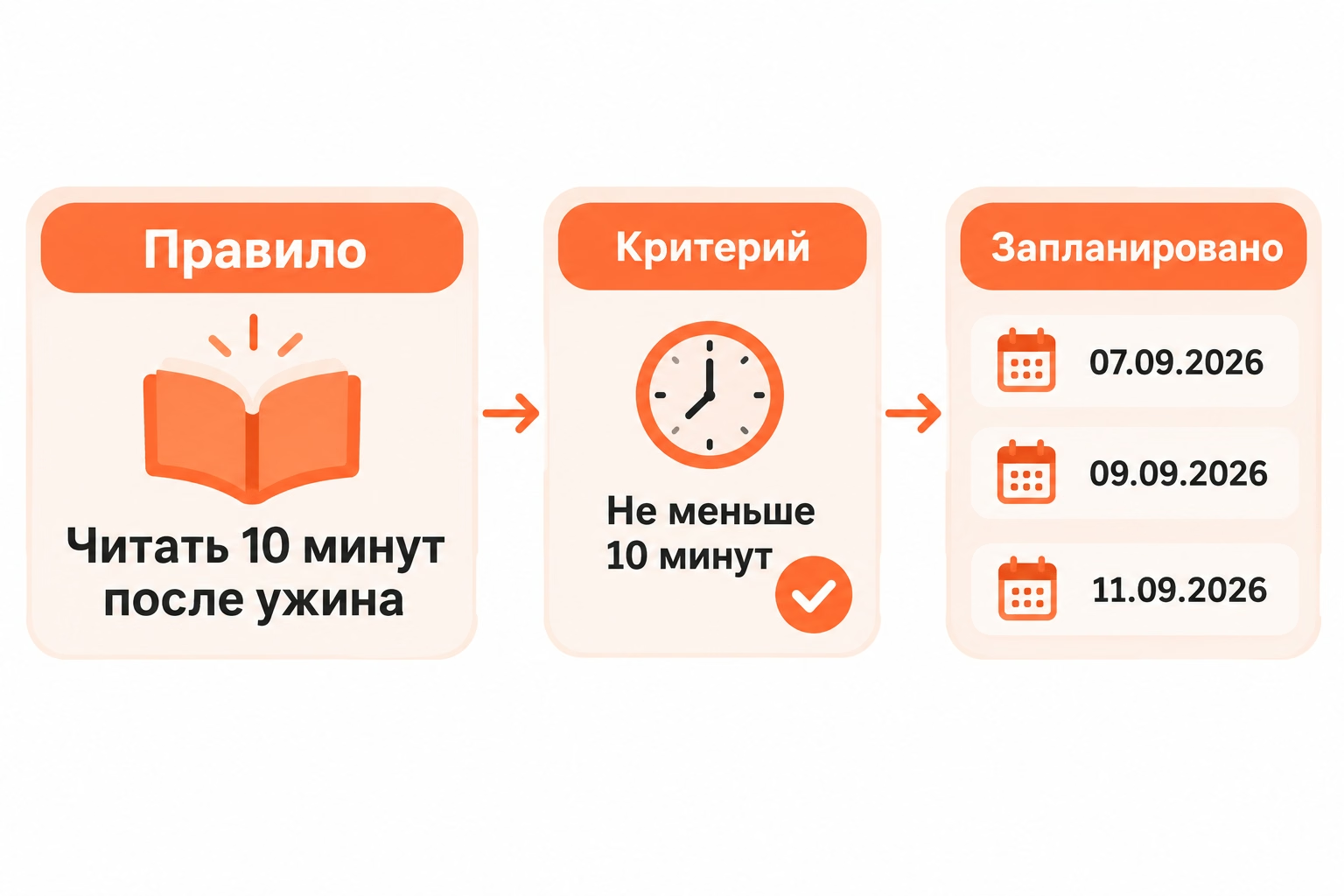
Read the book 10 minutes after dinner on Mondays, Wednesdays and Fridays.
The rule defines three elements:
- The action is to read a book;
- The minimum result is 10 minutes of reading.
- The schedule is Monday, Wednesday and Friday.
The wording “read regularly” is not suitable for a tracker. At the end of a day, it is impossible to determine the outcome. Ten minutes set a clear boundary: the criterion is either met or not.
One repetition should also be separated from the preparatory steps. Open a book, find the right page and turn on a timer – steps before reading, not independent habits.
To learn a language, the rule is based on the same logic: “After class, make out five new words.” At the end of the lesson, a specific fact remains: five words are disassembled or the action is not performed.
How repetition is different from a one-time task
Repetition refers to an action that is scheduled again on the following dates, and a one-time task ends after one result.
Buying a book is a one-off task. After the purchase, it is completed and does not move to the schedule of the next week.
Reading a book for 10 minutes is a repeatable action. Each scheduled date creates a separate fact:
- Reading September 7th;
- Reading 9 September;
- Reading September 11th.
History is made up of individual repetitions. One permanent Read a Book card, which is returned to the beginning of the board after each execution, erases the differences between dates. A week later, it is not visible when the action took place and when it was missed.
Steps within a single execution are not related to the history of repetitions. Opening a book or setting a timer helps to start today’s reading, but these actions do not require independent weekly accounting.
How to set a performance criterion
Set the minimum result after which a specific repetition is considered to be performed, and keep this criterion until the end of the selected period.
For reading, the rule is this:
Repeat after 10 minutes of reading.
If a person reads two minutes instead of ten, the actual result remains in the description of a particular record: “2 minutes, late start.” According to the original rule, such repetition does not reach the criterion of performance.
Separate status for a partial result in the first week will only complicate accounting. Three states – “Planned”, “Fulfilled”, “Missed” – retain a clear structure, and the details of the deviation remain inside the card.
The criterion is changed only for future repetitions after the review period. When switching from ten minutes to five, new cards record the start date of the new rule.
How to determine the schedule of repetitions
Assign specific dates within a single period and create records only for the days when the action is included in the plan. For the first cycle, take the week from 7 to 13 September 2026.
The reading schedule looks like this:
On Tuesday, Thursday, Saturday and Sunday there is no reading of the original schedule. An empty date these days does not mean a pass.
The daily schedule is based on the same principle: the expected repetition refers to each scheduled date. In an end-to-end example, three repetitions leave the story short and allow you to separately show execution, omission, and off-plan action.
The schedule should be placed in real load. When planning a day for repetition, time is allocated in advance next to existing activities, rather than adding a new record on top of a full day.
How to tie an action to an everyday event
Link the repetition to an event that is already happening on the selected day. In our example, reading begins after dinner.
The date answers the question on which day the action is expected. A clue event clarifies the moment inside the day.
The full rule looks like this:
September 7 after dinner - read 10 minutes.
Dinner takes place daily, but repetition is scheduled only for Monday, Wednesday and Friday. The event does not create a new record by itself, nor does it replace a schedule.
The date in the Canbano card records the scheduled day. Automatic reminders are not included in this scenario. If necessary, a separate external signal is configured independently of the board.
How to choose a format for marks
Choose the format according to availability at the time of action, the way history is stored and the amount of manual work. The same tracker is conducted on paper, in a table, a specialized application or on a kanban board, but the recording device is different.
Paper is suitable for one place and a small number of actions. The table compactly stores long periods and several lines with different repetitions.
Specialized trackers are designed specifically for regular activities. Replays, stats, reminders, and other features are product-specific, so they cannot be ported to any default service.
The Kanban board is suitable for a small number of repetitions, especially when personal affairs are already being conducted in the same space. With dozens of daily activities, individual cards create too much manual maintenance, and a compact grid is better suited to the task.
How to prepare the board for the first week
Create three states – “Planned”, “Fulfilled”, “Missed” – and a separate card for each date from the schedule.
You will need three cards for the first week:
- Read 10 minutes - 07.09. 2026
- Read 10 minutes - 09.09. 2026
- Read 10 minutes - 11:09. 2026
At the beginning of the period, all three cards are in the “Planned” column. The columns here reflect the state of each repetition: the future record waits for its date, the completed record records the fact of execution, the missed saves the unfulfilled plan. The same principle of card movement between working states is used when setting up a personal kanban board.
In all three cards, put the label “Reading” and the corresponding date. In the description we fix a single rule:
After dinner. Repetition is considered completed after 10 minutes of reading. Accounting period: 07.09.2026-13.09. 2026.
Fact:
Cause of deviation:
We do not create cards for September 8, 10, 12 and 13. The original schedule does not contain actions for these days, therefore, it is not necessary to count them as a wait or a pass.
In Kanbano, the card stores the description, date, marks, status, checklist and attachments. For a weekly tracker, a name, date, label and a short description with a rule are enough. The remaining fields are plugged only when they carry a useful context for a particular repetition.

The scheme remains manual: the planned cards are created in advance, and the final state changes after the actual action. Auto-repeats, automatic transfer and built-in statistics such setting does not imply.
What to store in a single repetition card
Store in the card information on which the plan and the actual result of a specific date are restored.
Four elements are enough to read:
- scheduled date;
- performance criteria;
- actual result;
- cause of deviation.
The September 11 recording looks like this:
Read 10 minutes - 11:09. 2026
Date: 11:09. 2026
Tag: Reading
Rule: After dinner, at least 10 minutes
Fact: not implemented
Reason: Back home late
A separate card retains the fact for September 11. After a week, the story is independent of the person's memory and doesn't mix multiple repetitions within a single record.
Preparatory steps such as “open the book” or “start the timer” are not added to the card without a separate reason. The tracker captures repetition and deviation from the plan rather than documenting every movement around the action.
How to record the results of each day
After the actual result, transfer the card of the desired date to the appropriate column. Performed repetition is sent to “Performed”, confirmed non-performance – to “Missed”.
On September 7, a person reads 10 minutes after dinner. The card "Read 10 minutes - 07.09.2026" goes to "Fulfilled".
On September 9, the same thing happens. The second card also goes to "Fulfilled".
There was no reading on September 11 due to a late return home. The card goes to "Missing", and the reason remains in the description.
The absence of a mark does not always mean a pass. If the next day the person does not remember whether the action was performed, the fact remains unknown. The description records “no data”, and the result is specified separately.
Twenty minutes of reading on Monday doesn't close Friday's repetition. Each scheduled date represents an independent fact.
A missed record is also not moved to another day for the sake of a continuous series. The date of September 11 and the result “missed” remain in history.
Additional reading on Saturday is formalized by a new entry:
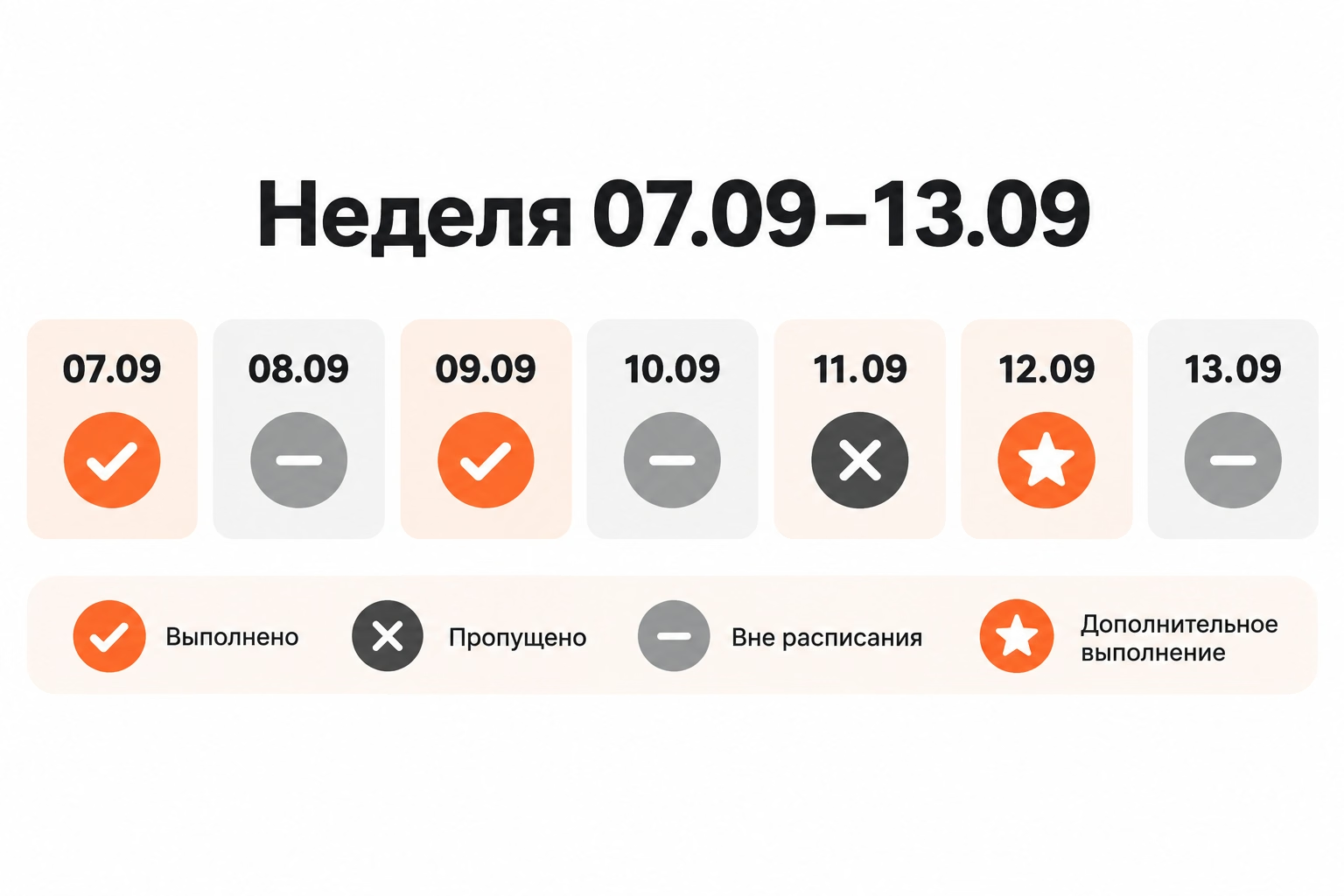
Read 10 minutes - 12.09.2026 - out of plan.
Saturday's card retains an additional fact but does not replace Friday's pass.
How is a pass different from a day off schedule?
The pass occurs only on the day on which the action was planned but not executed. A day without repetition on the schedule does not receive a negative mark.
Our week looks like this:
- September 7 – planned, completed;
- September 8 – no action on the plan;
- September 9 – planned, completed;
- September 10 – no action on the plan;
- September 11 – scheduled, missed;
- September 12 – additional implementation;
- September 13 - no action in the plan.
The original plan contains three repetitions, not seven. The calendar length of the week does not increase the number of expected actions.
Planned rest does not apply to passes. Otherwise, the tracker stops comparing the fact with the schedule and begins to consider the absence of action on any calendar day a mistake.
How to Discuss Week Results
Compare planned repetitions with actual results, then separately count omissions, unknown facts, and off-plan activities.
The story of the example goes like this:
Outcome of the initial plan:
- scheduled 3;
- completed according to plan - 2;
- missed - 1;
- Unknown facts - 0;
- completed in addition - 1.
Saturday's reading doesn't make the result "3 out of 3." It refers to a separate fact off schedule, and Friday's pass remains part of the original plan.
The reason for Friday's pass provides the basis for the next decision. The "late home" record does not indicate an abstract lack of discipline, but rather a conflict of timing with the actual schedule.
History shows the frequency of the chosen action. It does not confirm automatic habit formation, increased motivation, or the quality of reading.
If there are records “no data”, the result first fixes them in a separate number. An unknown fact is not turned into a pass for the sake of a full count.
After the first week, the same principle is transferred to its own action: start tracking, set a criterion and prepare cards for the upcoming dates.
How to continue accounting in the next period
Change one parameter of the future plan based on the actual week, prepare new dated cards and save the history of the past period without correcting the old results.
In our example, Friday's reading broke down because of a late return home. One change is chosen for the following week:
- transfer the Friday repetition to another day;
- reduce the minimum amount if the problem is related to the duration of action.
It is not necessary to change the day, time and criterion at the same time. A few changes will not immediately make it clear which parameter affected the next result.
Past cards retain their original dates and states. What is completed remains completed, Friday’s pass is missed, and Saturday’s recording is an additional action off-plan.
After review, completed records are transferred to the archive or left on the board, if the history of one week does not interfere with the current period. Canbano supports card archiving with subsequent recovery, so old facts do not need to be deleted for the sake of a clean workspace.

New cards of the next period are created manually according to the current schedule. With too much manual work, the number of tracked activities is reduced or moved to a more compact format.
When it comes to simplifying action
Reduce the minimum criterion for future repetitions when the current volume is not systematically placed in the actual load.
If ten minutes of reading conflict with the schedule several times in a row, the new rule is formulated as follows:
From 14.09.2026, the repetition is performed after 5 minutes of reading.
The date of change preserves the boundary between the two periods. Five minutes under the new rule and ten minutes under the old rule are different criteria, so they are not combined as completely the same results.
Simplification also applies to accounting. A tracker of dozens of cards that requires more attention than the action being tracked ceases to solve the original problem. Then reduce the number of repetitions in the accounting or change the format.
There is no fixed deadline for the completion of tracking. A weekly, monthly or longer period is chosen for the task of observation, and not for the universal number of days. The next cycle begins with a specific action: clarify the rule, assign dates, and prepare records for the new schedule.